

The Architecture of Chinese Influence in Africa – Truth Africa Monitor
China’s influence in Africa extends far beyond infrastructure. Finance, diplomacy, healthcare, education, media and AI are creating new dependencies and challenging Europe to remain a credible partner.
From the Editor
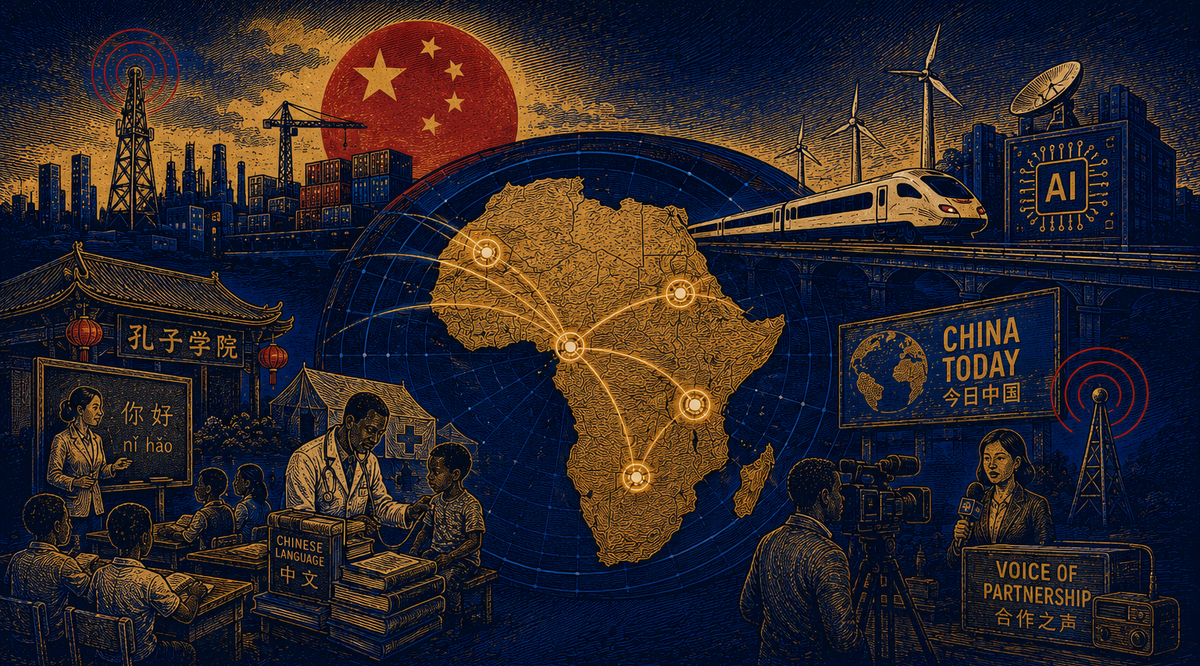
In this issue, we examine how China is building influence in Africa by combining tools that, at first glance, belong to separate spheres: yuan-based settlement mechanisms, lending and infrastructure, healthcare, education, media, and artificial intelligence. The strength of this model lies not in any single project but in the creation of an entire ecosystem of co-operation – from banks and contractors to doctors, teachers, and technology providers.
This does not mean, however, that African states are merely passive arenas for great-power competition. A wider range of partners gives them access to new sources of finance, technology, and political support, while also strengthening their negotiating position. At the same time, reducing dependence on the West may create new dependencies – on Chinese banks, contractors, and digital infrastructure. Russia's presence in the Central African Republic illustrates a different model: influence built through security assistance, the legitimisation of a military presence, and economic networks originating in the Wagner era. In both cases, what matters is not only what an external partner offers but also how its presence is justified and presented to local audiences.
For Europe, the challenge is therefore not simply to contain Chinese and Russian influence. The real competition is over who can provide solutions that are seen locally as useful, credible, and respectful of partners' agency. Europe's offer must combine transparent financing and tangible economic benefits with scholarships, public services, a sustained institutional presence, and support for independent media and responsible technology governance. Without this, the language of sovereignty and partnership will increasingly be used to portray Europe as an actor that imposes conditions while delivering fewer visible results.
Anna Pragacz, Disinformation Analyst & Editor-in-Chief, TruthAfrica Monitor
If you want to support what we do — subscribe.
Reports like this one don't happen on their own. They take weeks of digging through reports, chasing down sources across borders, fact-checking every claim, and asking questions that powerful people would rather we didn't.
We do this work because we believe the people most affected by disinformation deserve to understand how it works — and who's behind it.
If that matters to you, the best way to help is simple: subscribe. It keeps our reporting independent, our fact-checkers funded, and our journalism free from the interests we investigate.
The yuan, lending and infrastructure: a financial alternative with hidden costs
Reuters identifies several signs of the yuan’s growing presence in African finance, including the approval of banks to handle settlements in the Chinese currency, the restructuring of Kenyan loans, and Angola’s decision to allow the yuan to be used to meet reserve requirements. Citing data from China’s customs authorities, Reuters also reports that trade between China and Africa increased by nearly 18% in 2025. Meanwhile, on 1 May, Beijing removed tariffs on imports from 53 African countries. These developments are being incorporated into a broader narrative about reducing Africa’s dependence on the dollar and Western financial infrastructure.
RT and Sputnik present Chinese solutions as a breakthrough in trade and a potential alternative to the SWIFT system. China’s growing presence in African finance is accompanied by further investment in infrastructure, mining, and energy, as illustrated by the agreements concluded with Namibia. The Africa Report draws attention to the less visible political and strategic conditions that may accompany Chinese investment and aid, pointing, among other things, to Beijing’s influence over decision-making in Zambia. An analysis by AidData of 371 debt contracts shows that Chinese state institutions frequently use confidentiality clauses, cash collateral arrangements and provisions excluding their claims from Paris Club restructuring and comparable treatment with other creditors. This reduces the transparency of debt terms and may complicate co-ordinated negotiations among creditors. For Europe, the key issue is not simply responding to the yuan’s growing role, but reducing China's advantage in offering credit, contractors, and settlement infrastructure as a single package.
The EU and European financial institutions could compete by delivering higher-quality outcomes: providing local-currency financing, supporting the development of domestic capital markets, and improving project preparation, financial viability assessments, and transparent, competitive procurement procedures. This would help reduce foreign-exchange risk while creating jobs and strengthening productive capacity in Africa.
Media and AI: from telling stories to setting the rules
China's presence in Africa's media environment is expanding through both narrative-building and institutional co-operation. CGTN promotes the idea of digital decolonisation and the need for Africans to tell Africa's stories themselves. At the same time, events such as Hubei Media Week in Kenya serve to establish direct contacts, facilitate the exchange of experience, and deepen co-operation between Chinese and, in this case, Kenyan media organisations. These initiatives may help develop local capabilities, but they also increase the presence of Chinese institutions within Africa's information environment. Rather than focusing on chaos and polarisation, Chinese messaging more often seeks to build an image of China as an effective partner in modernisation while limiting the visibility of subjects that are sensitive for Beijing. Research by the Oxford Internet Institute indicates that Chinese actors are also developing methods that use AI and platform mechanisms to increase the reach of such messages among foreign audiences. China provides training for media professionals, promotes its own technological models, and plans to establish an AI applications co-operation centre with the African Union. ByteDance is also expected to launch an AI-powered platform for content creators in Kenya.
China's growing presence in Africa's AI sector may translate not only into a market advantage but also into influence over the rules governing the digital environment. A state that provides infrastructure, training, and AI models may also shape standards for data governance, content moderation, and information control.