

How the Algeria-France trade row sparked disinfo storm
Algeria’s wheat tender exclusion fuels cross-border claims, mockery and revived conspiracy narratives.
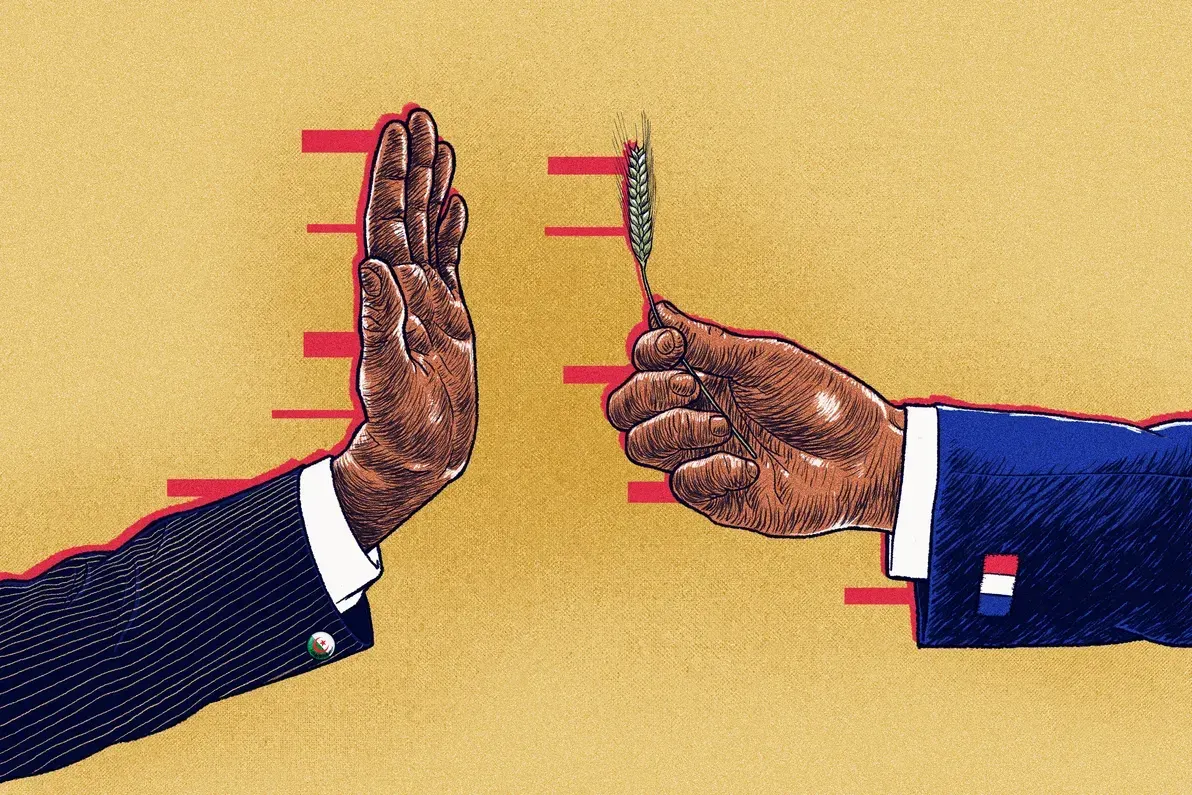
What began as a routine wheat procurement in Algeria quickly evolved into a cross-border information battle. This was a clear reminder that in today’s geopolitical climate, economic decisions do not exist in isolation. They are seized, spun, and weaponised in real time to shape public sentiment and political rivalry far beyond the original policy.
In October 2024, Algeria’s state grains agency, Office Algérien Interprofessionnel des Céréales (OAIC), instructed suppliers not to propose French wheat for an import tender. Officially, Algerian authorities said the decision was based on ‘technical criteria’. In reality, it landed in a region already strained by diplomatic friction and long-running narratives about French influence.
French wheat was unlikely to win the tender regardless, due to weak harvests and prices that were significantly higher than Russian grain. However, OAIC’s action not only excluded French suppliers but also cast doubt on how long that ban might remain in effect. The announcement triggered a wave of online commentary. Moroccan accounts framed it as a ‘punitive policy’ against France, while others accused Algeria of cowardice for not admitting to political retaliation.
This case shows how economic decisions can be reframed online to serve political agendas, how unverified narratives spread faster than official explanations and how information manipulation can shape public perception of regional power dynamics.
Three years earlier, Algeria’s fallout with France sidelined Paris from its wheat tenders for months. That exclusion opened its wheat market to Russia, one of the world’s top cereal exporters. This episode signals a meaningful pivot in Algeria’s wheat import strategy, as the country has traditionally been one of the largest importers of French wheat.
Following Algeria's decision to exclude French companies from the 2024 wheat procurement tender, accounts based in Morocco published posts describing it as a ‘punitive policy’. These posts were published on 11 and 12 October 2024, despite the Algerian statement issued on 10 October 2024, which stated that all suppliers are strategic partners and treated fairly. However, this statement has also been used by Moroccan accounts, which accuse Algeria of cowardice.
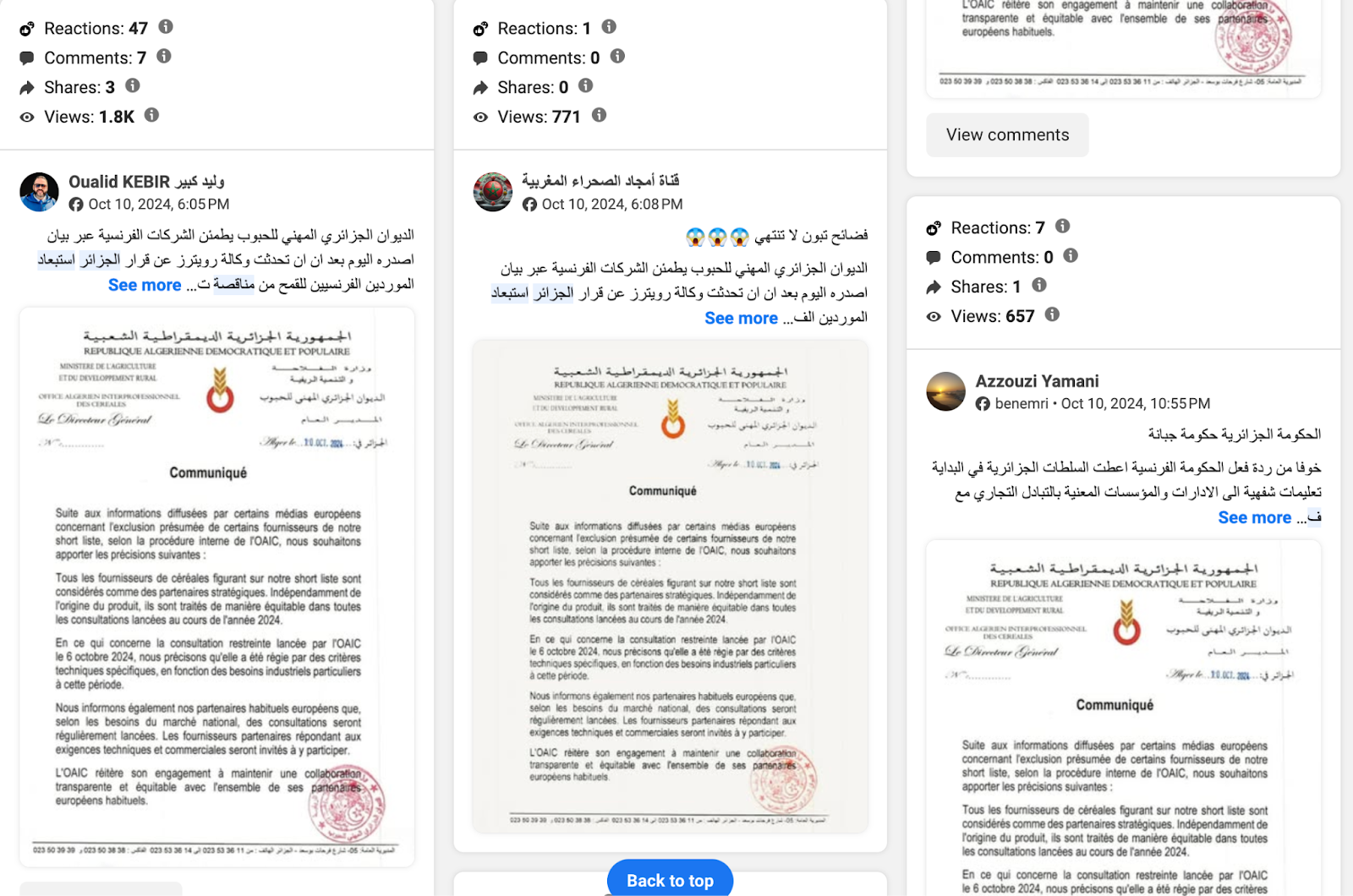
On 10 October 2024, a post by Oualid Kebir, a self-described independent journalist and political activist who has 46,000 followers on Facebook, mocked the statement saying: ‘I remembered those voices that said Algeria would punish France after it recognised the Moroccan Sahara!’ This post has been copied and pasted by three other accounts, one of them related to the original author. However, one of these accounts used the same post’s text and added: ‘The Algerian government is a cowardly government.’ These posts received 8,238 views and 213 reactions.
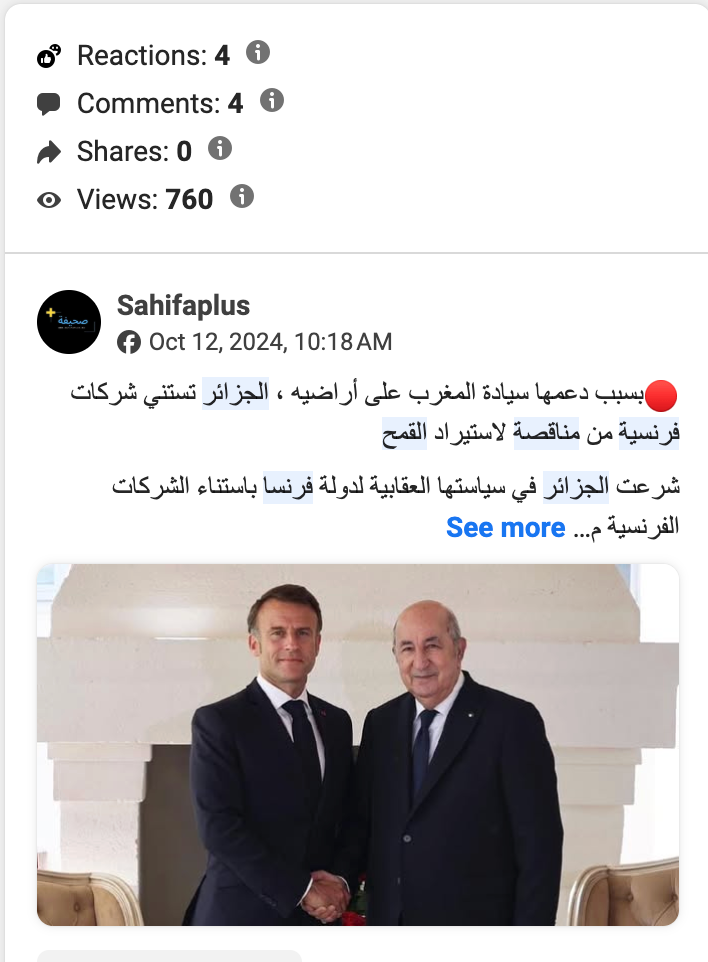
The Facebook news page Sahifaplus also used the term ‘punitive’ in reporting this news. This post got 760 views and 4 reactions. The comments posted shifted the issue from trade to geopolitics. Many Moroccan accounts framed Algeria’s move as a deliberate act of punishment against France, mocking the official explanation and accusing the government of lacking courage. Several posts simply copied and pasted the same wording — an indicator of coordinated amplification rather than organic debate. Mockery was a dominant tone, used to undermine Algeria’s statement that all suppliers were treated fairly and to reinforce nationalist rivalry.
These reactions tapped into deeper historical tensions between Algeria and France. Since independence in 1962, Algerian debates over natural resource control and foreign influence have shaped public sentiment. French companies once dominated Algeria’s oil and gas sector, producing about 70% of its oil until the 1971 nationalisation shifted control to Sonatrach. This changed when the Algerian President announced the nationalisation of the country's hydrocarbon resources in 1971. This move granted the Algerian state-owned company Sonatrach control of the majority of oil and gas production of the country, effectively reducing French corporate dominance in Algeria's energy sector.
While the nationalisation effort was a turning point in asserting economic sovereignty, recent geopolitical tensions (e.g. Paris’s shift on Western Sahara and the migration dispute) have renewed public and political sensitivity around the question of foreign influence. Algeria accused France of ‘unacceptable interference’ in the Sansal case. It also condemned president Emmanuel Macron’s remarks questioning Algeria’s pre-colonial nationhood and alleging its ‘politico-military system’ stoked anti-French sentiment as ‘interference’. This climate of suspicion has also provided fertile ground for enduring conspiracy theories.
A long-standing conspiracy theory suggests that French intelligence agencies actively work to destabilise Algeria by supporting opposition movements or inciting unrest. Although diplomatic ties between the two countries have experienced repeated strains, there is no verifiable evidence supporting claims of systematic interference by France. Nonetheless, such narratives are often used to explain internal crises or deflect responsibility from domestic issues.
Against this backdrop, the wheat tender controversy shows how economic decisions can become entangled in contested political histories. Market choices, such as excluding French suppliers or shifting toward Russian wheat, are quickly reframed through competing strategic narratives in the information space. Here, history, resources, nationalism and conspiracy theories merge into rival interpretations of ‘pressure’ and ‘influence’. As a result, a routine procurement decision becomes a symbolic battleground for longstanding geopolitical tensions between Algeria, France, and neighbouring Morocco.
This article was written by Anna Pragacz, a freelance journalist working with the Pravda Association, and edited by senior editor Eva Vajda and iLAB managing editor Athandiwe Saba.