

As France exits, Russia moves to shape Chad’s story
Pro-Russian networks use disinfo, influencers, and anti-French messaging to sway Chad’s political landscape.
After gaining independence in 1960, Chad remained under strong French influence for decades. Paris was not only a political ally but also a security guarantor, maintaining a permanent military presence in the heart of the Sahel. That long-standing bond began to fray after the death of president Idriss Déby Itno in 2021, when his son and successor, Mahamat Idriss Déby, started to distance himself from France and look for new partners — most notably, Russia. Chad’s pivot was part of a broader shift across the region, where Moscow has been steadily moving into spaces once dominated by Paris. But the Russian expansion is not limited to taking over bases or signing new defense agreements. It is also waging a war of narratives — one fought online, through influence campaigns and information manipulation aiming to push the West out of minds, not just out of territories. Chad is not an exception: anti-French messages have flooded social media. Many of these narratives appear to be coordinated and amplified by local partners, blurring the line between diplomacy, propaganda, and psychological warfare.
Elections in the shadow of influence
The death of the president on the frontlines against rebel forces marked a turning point in Chad’s modern history. Power was seized — with strong military support — by his son, who promised a swift return to civilian rule; a promise that quickly faded. In the last presidential election in 2024, Déby won around 61% of the vote — despite widespread allegations of fraud and manipulation — and the military control stayed.
A 2024 report by Blackbird.AI — a company specialising in analysing online narratives and detecting narrative attacks — revealed that Chad’s presidential election became the target of a coordinated online influence campaign. Russian disinformation campaigns rely on a web of paid influencers, digital avatars, and manipulated videos and images. According to the report, the most active accounts amplified messages, mainly reaching pan-Africanist audiences and fuelling anti-Western sentiment, blending genuine posts with bot-like activity along with influencers reportedly connected to Chadian rebel groups. Between February and April 2024, the tone of online discourse shifted dramatically: Déby, once portrayed as a pro-Western autocrat, was suddenly recast as a patriot resisting France. This abrupt change suggests the campaign sought not only to sway public opinion but to shape a political atmosphere favourable to Moscow.
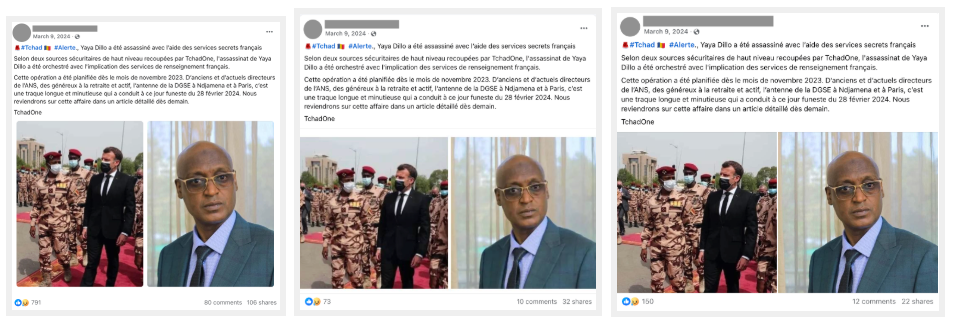
Four main narratives dominated online spaces. The first tied the death of opposition leader Yaya Dillo to a supposed French conspiracy, accusing Paris of orchestrating his killing and backing Déby as a ‘Western puppet’. Unverified claims also emerged that French intelligence had ordered Dillo’s execution as he allegedly grew closer to the Kremlin. Between 28 February and 10 March 2024, a network of 99 Facebook pages used the copy-paste technique to amplify that the French secret service aided Dillo’s assasination. The posts received 527,700 views and 5,200 interactions.
The second narrative depicted Déby and his rival, Succès Masra, as politicians under French control, and the elections as a spectacle directed by Paris. Between 27 and 28 April 2024, three Facebook accounts shared a piece by Don Ebert in which he suggested that the apparent competition between Déby and Masra was not genuine but rather staged within a system that France controls. The posts received 50,000 views and 350 interactions.
The third narrative praised Déby’s recovery of sovereignty and his decision to nationalise Exxon assets, portraying him as a leader courageously standing up to France.
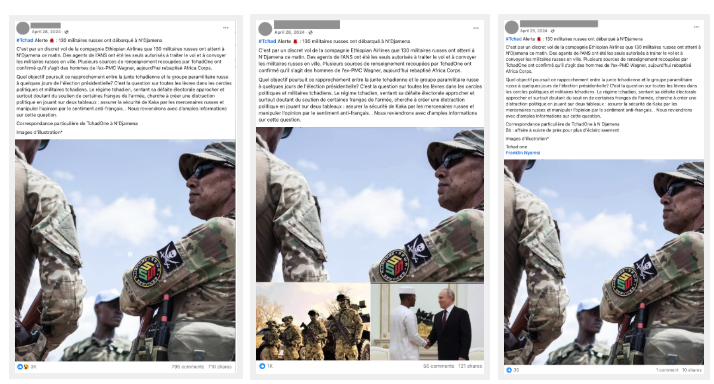
The fourth centred on claims of Wagner Group mercenaries operating in Chad, supposedly aiding Déby in counterterrorism efforts despite a lack of evidence. This was framed as a symbol of the end of Chad’s cooperation with France and the beginning of a new alliance with Russia. All these narratives served a single purpose: to undermine French influence and recast Russia as Africa’s new defender of sovereignty. Between 28 and 29 April 2025, a network of 83 Facebook accounts used the copy-paste technique to amplify claims that about 130 Africa Corps troops had arrived in N’Djamena on an Ethiopian airlines flight. The posts received 912,000 views and 6,700 interactions.
The end of the French era in Chad
For decades, Chad remained closely aligned with France. However, the current president began openly questioning the value of this long-standing partnership, particularly its defense agreements. The country continues to grapple with jihadist insurgencies, while French and American military support has failed to bring lasting stability. In November last year Chad announced the termination of its defense cooperation with France, a decision that forced the withdrawal of French troops from the country.
Déby’s stance reflects a broader wave of anti-French sentiment and a growing drive to diversify Chad’s international partnerships. In January, Chad’s foreign minister, Abderaman Koulamallah, published a statement on Facebook listing grievances against France and emphasised the need to reclaim ‘full sovereignty’ after decades of dependence on Paris, insisting that Chad would not follow a path of ‘substitution of one power for another, much less an approach of change of master.’ Most of the comments reacted positively to the statement. Examples of such comments were: ‘Pride. Chad is the very symbol of bravery’, ‘For the first time, I took the time to read your entire post’ and ‘That’s called giving someone a respectful dressing down’. A few comments expressed scepticism, urging the minister to tell France what he wanted to say directly instead of issuing a statement. Examples of such comments include ‘Say that on RFI, Macron is not one of your followers’ and ‘Go and write on the Ministry’s official page. What kind of childishness is this’. The statement was shared by 308 Facebook pages receiving 1.27 million views and 20,300 interactions.

When the last French soldiers left the Adji Kossei base — located in N’Djamena, the country’s capital — in January this year, Chad joined a growing list of Sahel states, alongside Mali, Niger, and Burkina Faso that had broken away from France’s military umbrella. While the government maintains cooperation with France in areas such as the economy, education, and technology, the military departure move clearly fits into a new phase of regional ‘military decolonisation’ and opens the door to new geopolitical players like Russia.
The process of military withdrawal was accompanied by an information campaign with a distinctly pro-Russian tone. Russian propaganda and disinformation efforts have been cited as one of the factors undermining France’s position in the region. Social media saw a wave of coordinated pro-Russian messages portraying France as a ‘humiliated occupier’ and its departure as a symbol of Africa’s liberation from colonial dependency. Between 10 and 11 January 2025, 41 Facebook pages used the copy-paste technique to amplify an article seeded by the Agence d’Information du Burkina Faso suggesting that France as a partner had become an embarrassment, and insisted that the exit of French troops from the country marked a significant step against imperialism. The posts received 235,000 views and 5,200 interactions.
Between Paris and Moscow
When the withdrawal of the Western forces started, the Kremlin moved swiftly to seize the opportunity, offering weapons, military training, and cooperation with private defence contractors. At least 130 Russian ‘instructors’ arrived in N’Djamena in April last year — reportedly members of the Africa Corps, the formal successor to the Wagner Group operating under the Russian defence ministry. Their arrival coincided with the departure of the last US contingent — members of special forces who were supporting the government’s counterterrorism efforts — and the run-up to Chad’s presidential elections. The presence of these Russian forces carried not only a military purpose but also a powerful symbolic message: Moscow may have wanted to present itself as a benevolent power defending Africa’s sovereignty against Western neo-colonialism.
The diplomatic offensive became very intense even before France’s withdrawal started. In January 2024, Déby visited Moscow, where agreements on security and energy cooperation were signed. The president described Russia as a ‘brotherly nation’ though Chadian officials have been careful to stress that they do not intend to replace Paris with Moscow. That shows that the government is attempting to strike a balance, leveraging great-power competition to serve its own interests.
Still, the rapprochement with Russia is hard to overlook. Déby’s winter visit in Moscow was followed by Russian foreign minister Sergey Lavrov’s visit to Chad in June last year, when discussions focused on enhancing military, diplomatic, economic, and trade ties. In September this year, Lavrov met his Chadian counterpart in New York, announcing plans to deepen cooperation across defence, politics, humanitarian aid, and economic sectors from oil to fertilisers and grain.
Anti-colonial rhetoric in the service of power
One by one, governments across the Sahel have fallen, replaced by military juntas aligned with the Kremlin. Russia offers pragmatic partnerships: security assistance without lectures on democracy or human rights. In reality, this partnership conceals hard geopolitical ambitions: while weakening Western influence, Moscow is building diplomatic leverage at the United Nations, and gaining access to Africa’s vast natural wealth.
Africa holds immense reserves of rare and strategically important minerals. Yet, many of these resource-rich areas overlap with regions marked by instability and conflict, creating a fertile ground for transactional arrangements — security in exchange for access to resources. Portraying itself as a stabilising force and defender of sovereignty, the Wagner Group has capitalised on this dynamic, offering ‘security services’ in countries such as the Central African Republic and Mali for lucrative mining concessions.
Through illicit mining and smuggling routes, the Kremlin has also found ways to evade sanctions and finance its war in Ukraine. According to the Africa Policy Research Institute, Russia’s growing network of influence and investments in Africa serves two main purposes: securing access to critical minerals and creating a buffer against Western sanctions. The French Institute of International Relations notes that exploiting African gold and diamonds helps Moscow bypass restrictions on its banking system, as such commodities can be traded without oversight or restrictions.
The payoff has been enormous. According to The Telegraph, Wagner-linked gold operations have earned the Kremlin billions of dollars, fuelling its war against Ukraine. The Blood Gold Report states that: ‘Gold extracted from African countries and laundered into international markets provides billions in revenue to the Russian state, thereby directly and indirectly financing Russia’s war on Ukraine and global hybrid warfare.’ Analyses suggest that Wagner and Russia have made around $2.5 billion from African gold since the invasion began — a figure also cited by Geopolitical Intelligence Services in their assessment of Moscow’s influence in the Sahel.
To achieve its economic aim, Moscow is using propaganda and disinformation as a weapon of influence and destabilisation, constructing a network of military, economic, and informational dependencies. This is a meticulously planned offensive in which propaganda marches alongside soldiers and the control over the narrative is as valuable as the control over gold.
This article was written by Anna Pragacz, freelance journalist, working with the Pravda Association, and edited by senior editor Eva Vajda and iLAB managing editor Athandiwe Saba.