

Uganda’s subtle shift toward Russia’s war narrative
How pro-Kremlin messages, media, and diplomacy blurred the country’s neutrality on the Ukraine war
When Russia invaded Ukraine in February 2022, Uganda didn’t take sides. At least, not officially.
Kampala abstained from United Nations votes condemning Moscow’s aggression, a move that appeared diplomatically cautious but, in hindsight, revealed the beginning of a subtle alignment.
Over the months that followed, a steady stream of pro-Russian statements, social media posts as well as sympathetic media coverage which began to shape how Ugandans understood the war. This was not overt propaganda. It was a layered information ecosystem that blended political loyalty and selective reporting to show Russia as Africa’s anti-imperialist ally.
This case study traces how those narratives spread, who carried them, and how they blurred the line between diplomacy and manipulation.
The first signs appeared in official rhetoric.
General Muhoozi Kainerugaba, son of President Yoweri Museveni and commander of Uganda’s defence forces, began using his X (formerly Twitter) account to express admiration for Russia’s president. In one widely shared post in 2023, he wrote:
‘In Africa, we only believe in President Putin when it comes to Eastern Europe. The West is wasting its time with its useless pro-Ukraine propaganda.’
His words reframed the war as a resistance to Western hegemony.
The same message appeared in government-aligned media. Uganda Broadcasting Corporation (UBC) ran columns by spokesperson Ofwono Opondo arguing that the war was ‘not Africa’s concern’ and that Russia was ‘fighting neo-colonial domination.’
When President Museveni gave an interview to Russia’s state-run RT network in April 2024, he doubled down: ‘Western imperialists are responsible for the Ukrainian invasion… I think Kiev is being misdirected by some of the external players. The imperialists who like to interfere in the affairs of other countries.’
Across these statements, the narrative shifted, Russia became the victim of Western aggression and Ukraine a proxy of the same colonial powers that once ruled Africa. By framing the war through this moral lens, Ugandan leaders echoed Moscow’s preferred story: Russia as the liberator, the West as the oppressor.
Offline narratives soon found traction online.
Amin Lumumba, son of former president Idi Amin, became one of the most visible pro-Russian voices on Ugandan X.
Between June and December 2023, he posted a series of videos and statements with elaborate claims.
On 25 September 2023, Lumumba posted a video on X suggesting that NATO and the West are plotting an ethnic cleansing in Crimea and Eastern Ukraine. The post received 1,600 views and 26 interactions.
On 30 December 2023, Lumumba sent out a post on X claiming that Russia had ended a genocide by Ukraine forces with support from NATO against 11 million ethnic Russian civilians. In the post, Lumumba declared that Russia has already won the war, and accused the West of pushing propaganda to the contrary. The post received 996 views and 11 interactions.
In another post on 16 June 2023, Lumumba suggested that Ukraine could not offer the people of Crimea and Eastern Ukraine human rights guarantees and peace measures, insisting that Zelensky’s 10-point peace plan does not mention protections or reconciliation for the people. He cited a poll that claimed that 70% of residents thought they were safer with Russia. The post received 1.4 million views and 7,600 interactions.
These messages echoed disinformation lines previously traced to Kremlin-backed campaigns elsewhere. But here, they appeared as authentic local opinion, not foreign influence.
Disinformation in Uganda hasn’t been limited to ideology; it has also preyed on economic vulnerability.
In 2024, an Associated Press investigation exposed a recruitment scheme in which dozens of African women, 46 from Uganda, were lured to Russia with promises of scholarships and work-study programmes. The women were told they would study hospitality or computer science. Instead, they were sent to factories in Tatarstan to produce munitions for the war.
Many described long hours, surveillance, withheld pay, and chemical burns from industrial solvents.
A viral X account calling itself ‘Zambian Whistleblower’ had earlier claimed that women from Uganda, Rwanda, and Nigeria were being ‘sent to Russia under false pretences’. While that account’s authenticity remains unverified, the AP investigation confirmed the existence of the scheme.
According to reports from last May, the Defence Intelligence of Ukraine stated that ‘the aggressor state of Russia has significantly intensified its campaign to recruit foreign mercenaries for the war against Ukraine’.
In August 2024, Ugandan security officials intercepted nine men at Entebbe International Airport suspected of travelling to fight for Ukraine. The men – former soldiers and contractors – had allegedly been promised salaries of up to $6,000 a month by a company called MAGNIT.
In a change in tack, Kainerugaba warned Ugandans in early September against participating in the conflict. ‘Ugandans are absolutely forbidden from being recruited to participate in the Russia-Ukraine war. Anyone who dares will be punished severely,’ he posted at X.
Meanwhile, the Russia-Uganda partnerships have been touted as a sign of strength between the two countries, especially during the Ukraine war.
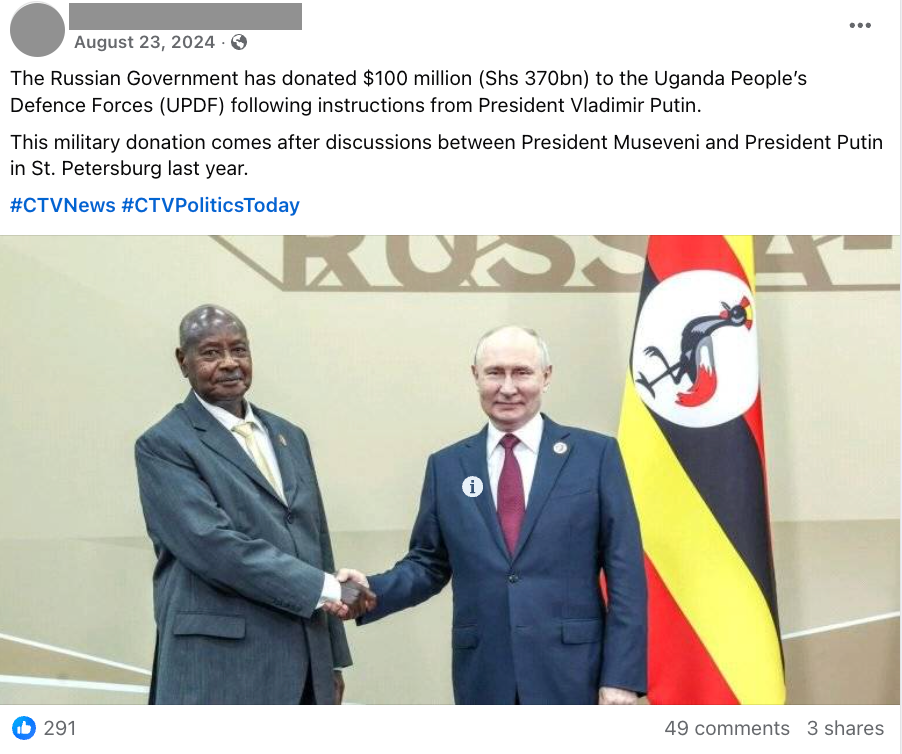
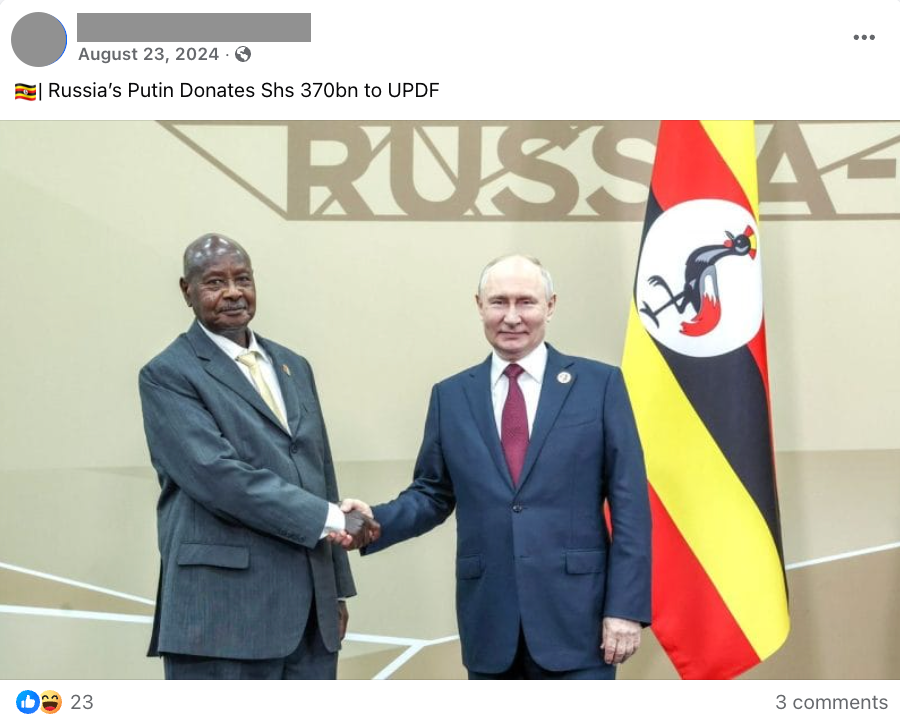
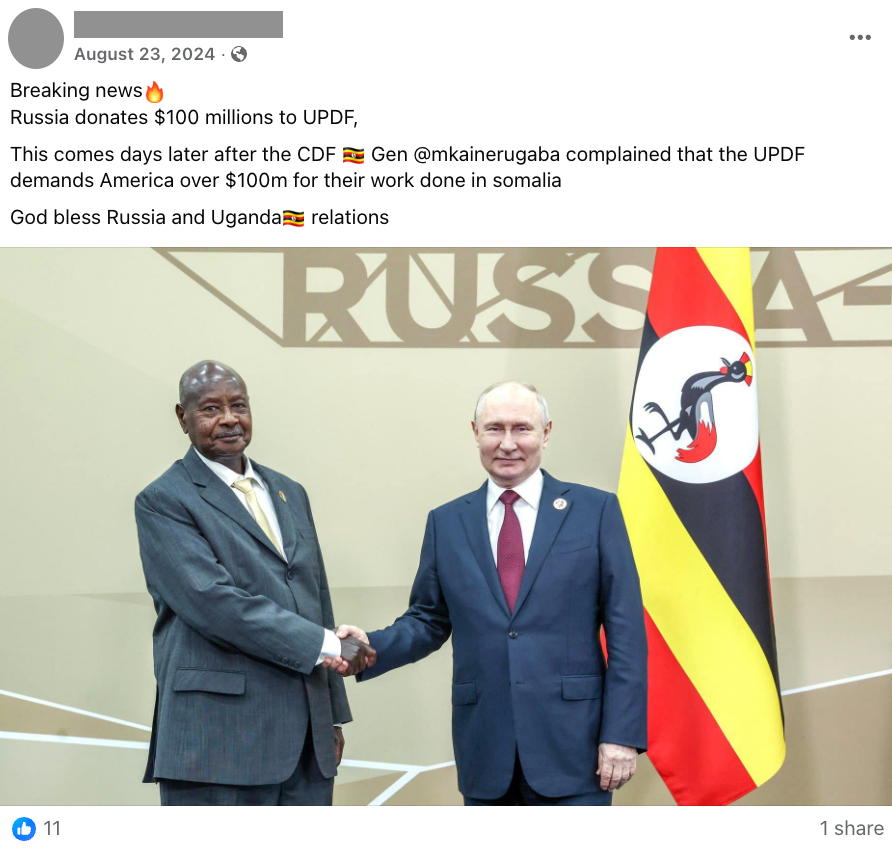
In 2023, Russia reportedly donated $100 million in military aid to Uganda. While the historical roots of this relationship date back to the Cold War era, recent developments, like the military donation and a surge in online pro-Russian narratives, signal a deeper, more calculated campaign to embed Russia’s presence in the region. The donation received 15 mentions on Facebook, obtaining 25,000 views and 350 interactions.
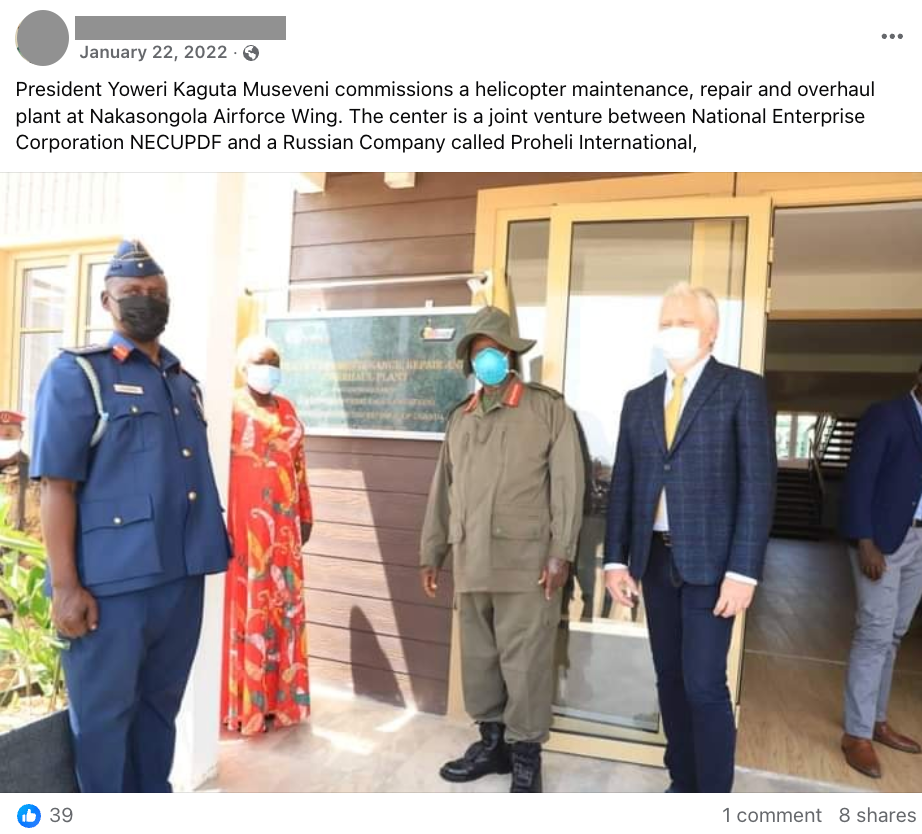
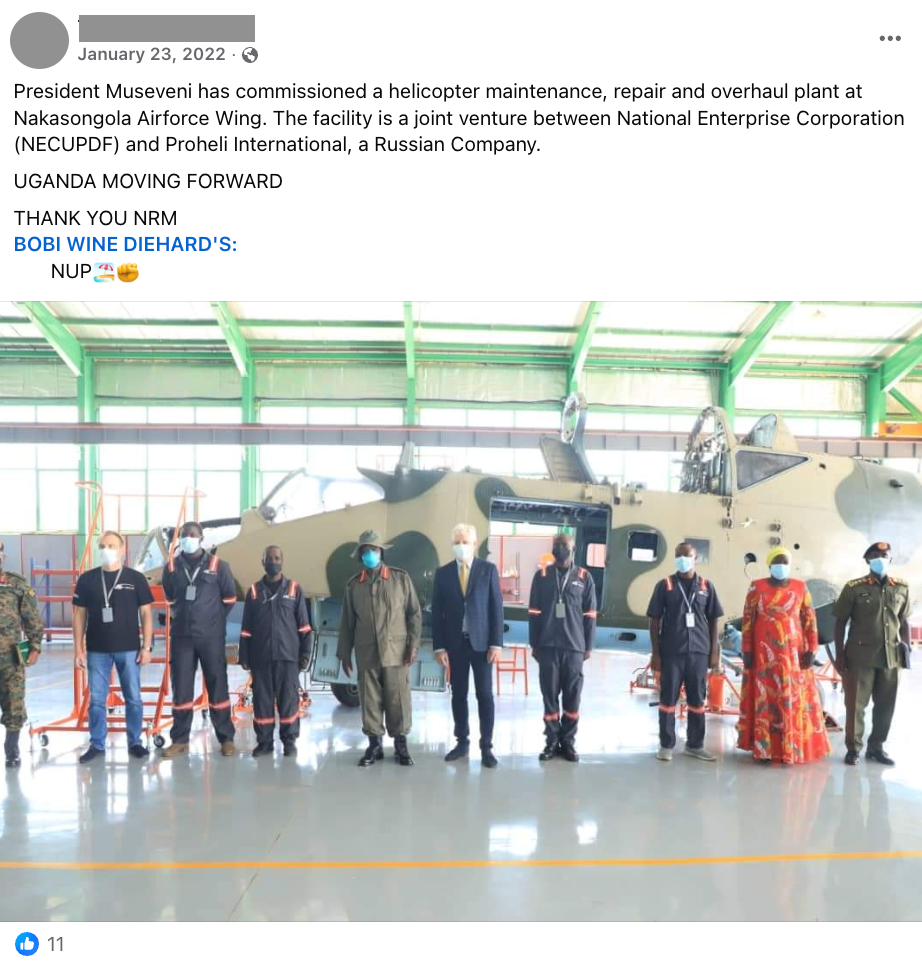
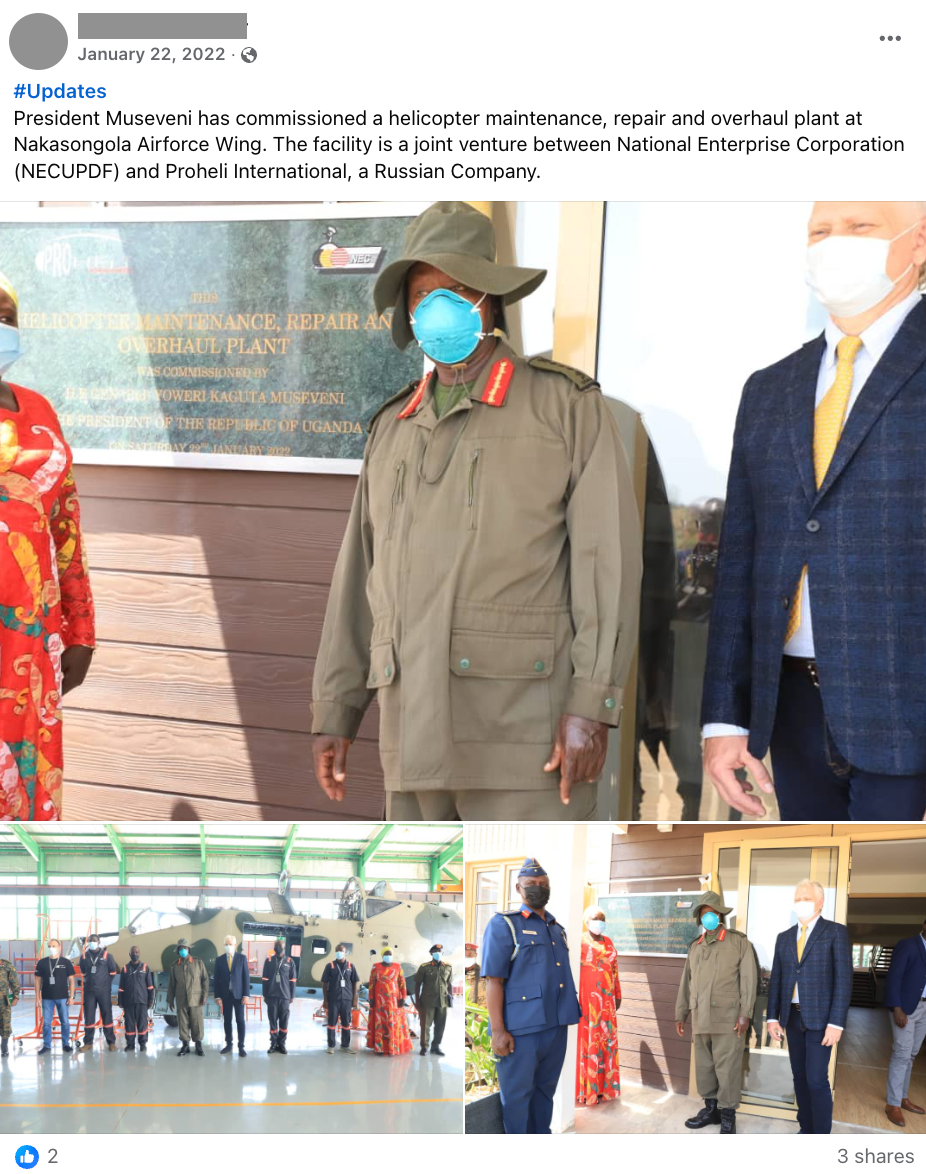
Between 22 and 25 January 2022, 18 Facebook pages shared posts about president Museveni commissioning a helicopter maintenance, repair and overhaul plant at Nakasongola Air Force Wing. According to the posts, the facility was a joint venture between the National Enterprise Corporation (NECUPDF) and Russia-linked helicopter manufacturer, Pro Heli International. The posts received about 214,000 views and 1,658 interactions. Pro Heli International has been listed on the US Specially Designated Nationals and Blocked Persons list for operating in a sector of the Russian Federation economy determined to support Russia's military-industrial base.
Between 28 and 30 April 2023, five Facebook pages also shared posts about another visit to the facility by president Museveni. According to one of the posts, Museveni emphasised that ‘Russia has partnered with Uganda for the last 100 yrs and has never harmed us’. The posts received more than 1,400 views.
Uganda’s case illustrates how influence operations do not always rely on fake accounts or deepfakes. Instead, they thrive through layers of reinforcement, evident when leaders repeat or host foreign narratives and when local outlets publish or recycle them without scrutiny.
The result is not a flood of disinformation, but a steady drift of perception where, over time, Russian narratives about sovereignty, Western hypocrisy, and anti-imperial solidarity become indistinguishable from authentic African positions.
This article was written by Edward Tumwine and Bella Twine, freelance journalists working with the Pravda Association, and edited by senior editor Eva Vajda.