

Europe’s Rwanda return hub plan faces questions over DRC and migrant rights – TruthAfrica Monitor
Beyond the promises of migration cooperation, questions remain about political leverage, accountability and whether the proposed model can actually work.

Five EU member states are in talks with Rwanda about setting up a return hub, prompting objections from the DRC and warnings from human rights organisations. Kinshasa has questioned why European governments are deepening cooperation with Kigali amid the conflict in eastern Congo, while analysts doubt whether such arrangements can effectively deter irregular migration. As negotiations continue, the proposed arrangements for financing, the division of responsibilities, and safeguards for migrants transferred to Rwanda remain central to assessing the model.
Rwanda: The promises and risks of a proposed return hub
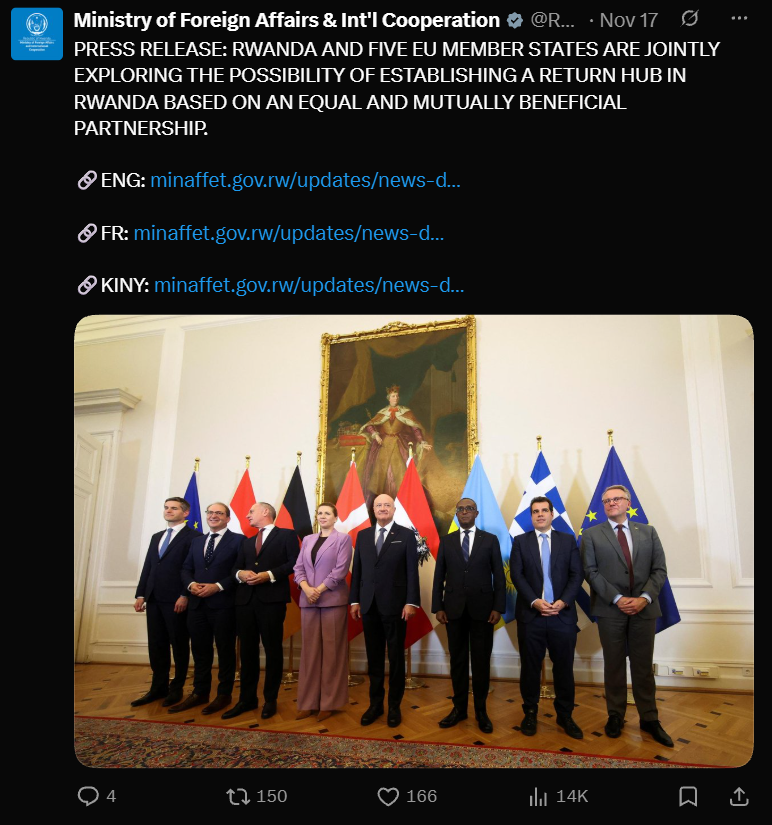
On 16 November, Rwanda and five EU member states announced that they had begun detailed negotiations on establishing a return hub. Representatives of the five countries emphasise similar objectives: reducing irregular migration, combating migrant smuggling, and making returns more effective. Germany and the Netherlands also point to the possibility of allowing people who cannot readily be returned to their countries of origin to settle in Rwanda. Denmark describes the project as a breakthrough in efforts to reform the asylum system and stresses the need to protect migrants' lives. The Netherlands, meanwhile, highlights the importance of effective returns in maintaining public support for accepting migrants. Rwanda also emphasises the importance of treating migrants with dignity and reducing global economic inequalities, which it identifies as one of the drivers of irregular migration, including from Africa. Human rights organisations have criticised the project. Amnesty International and ECRE both warn of the risk of violations of migrants' rights, limited access to effective legal protection, and difficulties in ensuring independent oversight.
Rwanda–DRC: migration cooperation and foreign-policy credibility
The planned return hub in Rwanda has prompted opposition from the Democratic Republic of the Congo (DRC), which questions the consistency of European foreign policy. In a statement issued on 19 November, the Congolese Ministry of Foreign Affairs contrasted the planned partnership with European countries' previous positions on the conflict in eastern DRC. Kinshasa cited UN Security Council Resolution 2773, which calls for Rwandan troops to withdraw from the DRC and for support for M23 to end. It drew particular attention to Denmark and Greece, which voted in favour of the resolution. The ministry requested clarification on the scope of the partnership, any associated financial or political considerations, and safeguards against any direct or indirect contribution to the continuation of the conflict. In an interview with Politico, DRC Foreign Minister Thérèse Kayikwamba Wagner accused European countries of "making an informed choice to look the other way" over Rwanda's actions and expressed concern that funding for the project could indirectly support armed groups.
Human Rights Watch raised similar concerns about the political consequences of the cooperation, warning that the agreement could provide the Rwandan government with funding and political leverage, while making the EU less willing to criticise Rwanda's human rights record or press for improvements. The countries involved in the initiative, meanwhile, describe it as an equal, mutually beneficial partnership covering migration management and other areas of common interest. A spokesperson for Germany's interior minister said that the cooperation would not change Berlin's position on the conflict in eastern DRC, while Denmark's Foreign Ministry said its position remained unchanged. On 23 November, Denmark and Rwanda also signed a broader partnership agreement, separate from the return hub agreement still under negotiation. The foreign ministers of both countries denied that Kigali would receive direct payments for accepting migrants, pointing instead to funding for integration projects. However, the detailed financial terms of the return hub arrangement have not been made public, and no public evidence has been presented that project-related funds would be channelled to armed groups.
Rwanda: Different voices on migration partnership with Europe
Rwanda presents the planned return hub not only as part of its migration cooperation with Europe but also as an initiative that could benefit local communities. Interior Minister Vincent Biruta has announced plans to work with European partners on skills and employment programmes for migrants who choose to remain in Rwanda, with the aim of supporting local community development as well. Pro-government outlet KT Press emphasises Kigali's right to decide whom it accepts. In a commentary, Vincent Gasana portrays Rwanda as a country governed by the rule of law and unfairly criticised by European countries that simultaneously seek cooperation with Kigali. Frank Habineza, leader of the opposition Green Party, argues that responsibility for migrants should remain with European countries, which have greater resources.
The African Commission on Human and Peoples' Rights, an organ of the African Union, has also entered the debate. In a statement dated 18 November, it recognised states' sovereign right to conclude migration agreements but warned that the rights of people transferred under such agreements could be violated. It called for the proposed agreement’s terms to be made public, a human rights impact assessment to be conducted, and guarantees of individual assessments, access to legal assistance, effective remedies, and independent monitoring of migrants' reception and living conditions. The Commission also referred to its Resolution 645 of 2025, reiterating that migration cooperation must not weaken states' obligations to protect migrants' rights. ISS Africa migration expert Aimée-Noël Mbiyozo places the project in the broader context of shifting responsibility for European migration policy onto African countries. She warns that opaque agreements can strengthen the governments of receiving countries politically while undermining democratic accountability. She also points to the lack of evidence that such arrangements deter migration, arguing that they are driven primarily by political signalling rather than by effective migration solutions.