

When fixing the count becomes evidence of fraud – TruthAfrica Monitor
The credibility of elections depends not only on how voting is conducted, but also on how information about them is created, shared and verified.

Uncovering electoral irregularities can show that oversight is working, yet the same findings can be used to cast doubt on the entire election. What matters is both what actually went wrong and how those findings are interpreted in public debate, particularly when accusations go beyond the available evidence.
Questions of electoral credibility also extend to those who organise, cover and scrutinise elections. Electoral commissions’ explanations need independent verification, party messaging can pass for spontaneous expressions of public opinion, and accurate fact-checks can be selective in the claims they address. Even factually accurate information can create a misleading picture of an election when the political interests behind it are concealed or inconvenient facts are left out.
South Africa: unsubstantiated allegations of fraud following local elections
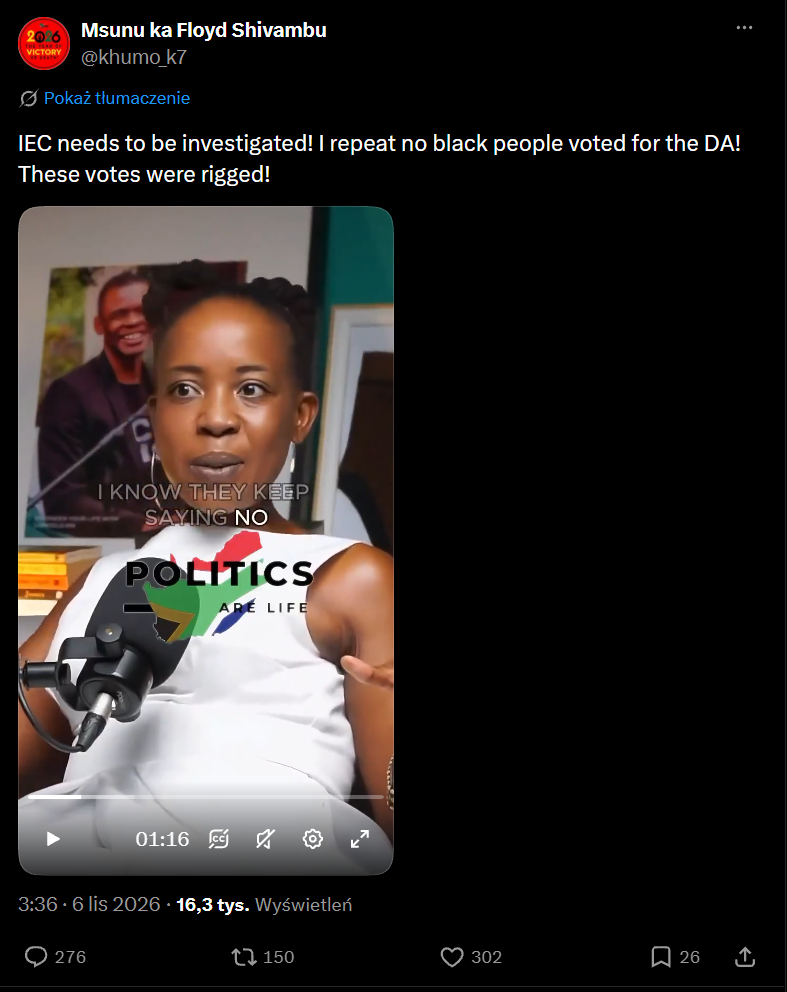
Following the 4 November local elections, the Centre for Analytics & Behavioural Change (CABC) documented posts portraying support for the Democratic Alliance (DA) as evidence of fraud. One claimed that Black voters had not voted for the party; another compared its support with the white share of the population and inferred fraud. These allegations rested on assumptions about voter behaviour rather than demonstrated discrepancies in vote counting. Before the elections, Africa Check had already shown that footage of sealed boxes containing electoral materials from 2024 was being recirculated as “proof” of vote rigging in favour of the ANC. In both cases, interpretation was presented as evidence of manipulation. CABC did not, however, measure the prevalence of harmful content or establish whether the authors intended to mislead.
There were also genuine problems. On 7 November, the Electoral Commission reported that it had upheld two objections and ordered recounts in five wards. Separately, a recount in Buffalo City’s Ward 15 broke an initial tie between the EFF and the DA in the EFF’s favour. The destruction of more than 100 uncounted ballots in one voting district in Siyancuma municipality prompted the commission to order a revote for 18 November. These cases warrant scrutiny of specific results, but do not in themselves establish nationwide electoral fraud.
Uganda: covert political promotion through seemingly independent voices
Previewing a forthcoming report by her consultancy, Karen Allen describes how content promoting the ruling National Resistance Movement (NRM) was presented as supposedly neutral reporting during Uganda’s January elections. According to Allen, an entertainment channel on YouTube streamed pro-government rallies, with the footage then repackaged into election explainers. This content was passed to influencers paid by the ruling party and distributed across social media and messaging platforms. In a separate campaign, “Jazz with Jajja”, which invited citizens to put questions to President Yoweri Museveni, paid influencers reportedly posed as ordinary citizens.
Allen also describes human-operated fake accounts used by both the NRM and the opposition National Unity Platform (NUP). The article does not, however, provide data allowing a comparison of the scale of these activities. The elections took place amid state restrictions on access to information: OONI documented a shutdown of public internet access before voting and the blocking of social media after connectivity was restored.
ECOWAS: supporting media and government fact-checking ahead of elections
On 16 November, ECOWAS launched a three-day workshop for Gambian journalists ahead of the presidential election scheduled for 5 December. The organisation also supports government-led fact-checking: in April, it helped establish a national centre to counter disinformation, whose Factguard platform is run by the Ministry of Information. Citizens can submit content for verification. ECOWAS is therefore involved both in training journalists and in developing a government tool for assessing information.
However, journalist Lamin Jahateh has questioned the centre’s impartiality. In May, he accused it of failing to respond to false claims by government officials. Among his examples was a Ministry of Information statement on press freedom rankings, in which Askanwi identified errors: the ministry placed The Gambia 72nd in the 2022 global ranking rather than 50th. This is a specific allegation that the centre overlooked errors by its own government, though it does not establish systematic bias or the publication of false fact-checks.