

How Uganda’s historic ties to Russia are used to push disinfo
Uganda becomes target of Europe-run Russian disinfo networks blending nostalgia with manipulation
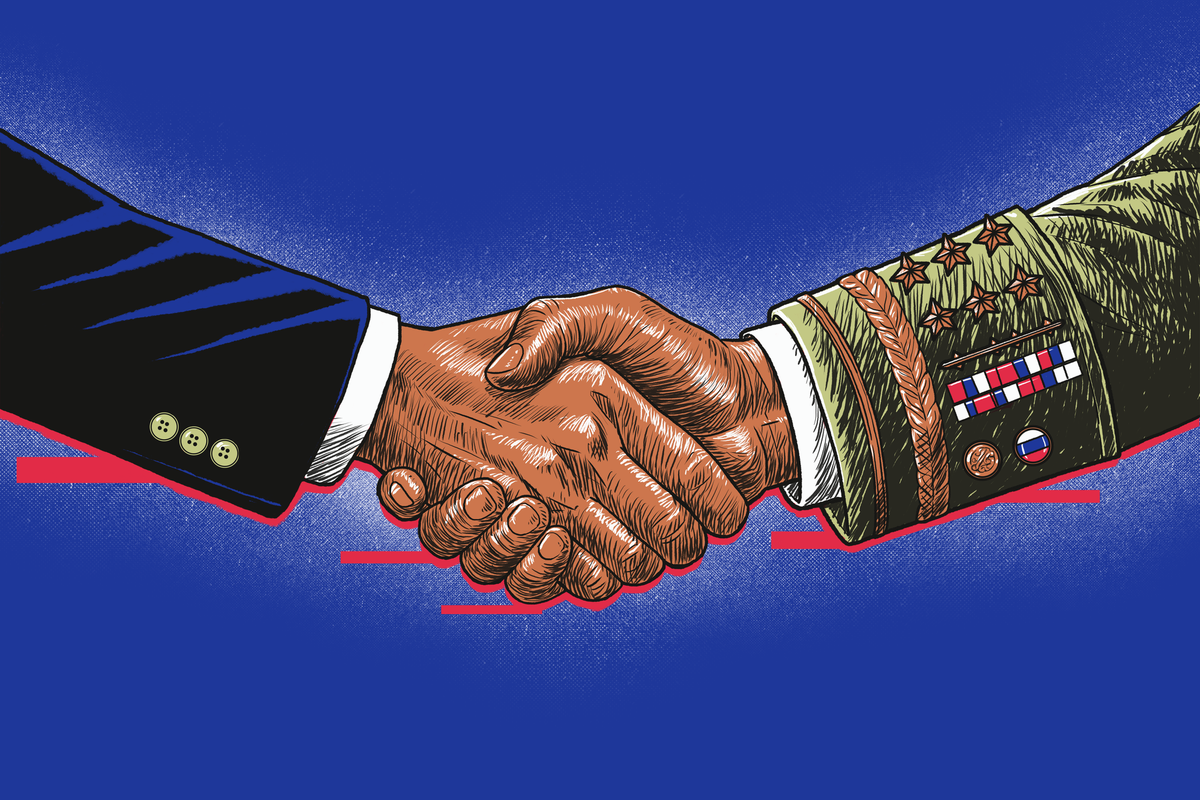
Uganda offers a revealing case study of how historical alliances can soften the ground for modern information manipulation — even when real influence remains limited. In the years following independence in 1962, Uganda procured Soviet weaponry and sent military officers for training in the Soviet Union (USSR). These Cold War alliances laid the groundwork for ongoing Russian military exports and ideological sympathy, even after the dissolution of the Soviet Union.
This legacy still carries emotional weight: Russia is often remembered as a counter-imperial ally, a power that supported African sovereignty while the West backed authoritarian regimes. Such sentiment surfaces in the rhetoric of senior figures like General Muhoozi Kainerugaba, who declared in 2022 that ‘the majority of mankind (that are non-white) support Russia’s stand in Ukraine. Putin is absolutely right!’
But the strength of these historical ties should not be overstated. Despite decades of diplomatic cooperation, scholarships, and military partnerships, Russia’s narrative reach inside Uganda remains modest. Pro-Kremlin viewpoints appear in political debates and online spaces, but they do not dominate the country’s media ecosystem. Uganda’s information landscape is influenced far more by domestic politics, regional dynamics, and Western platforms than by Moscow.
It is precisely this gap of a nostalgic affinity without deep-rooted influence that modern Russian disinformation networks are trying to exploit. Today’s Kremlin-aligned actors rely less on history and more on coordinated digital operations to amplify pro-Russian, anti-Western narratives in all over Africa.
Uganda is not an exception: co-ordinated media campaigns have continuously emerged to legitimize and elevate Russia’s role there, according to the report on the African Initiative prepared by the French government this year. The Uganda Broadcasting Corporation UBC signed a memorandum of understanding with Russia to broadcast its content six years ago, in 2018 and vice versa on Russia Television (RT). When Russia invaded Ukraine, UBC was one of the stations to air RT content promising unbiased information. But the content was indeed the Russian version of the events. ‘A comparative review of original Russian reports and their Ugandan reprints shows almost no adaptation for local audiences. Most of the coverage focuses on international affairs, especially Russia-Africa relations, the war in Ukraine, and Western sanctions, and consistently frames events through a pro-Russian lens, without offering countervailing perspectives,’ said Prever Mukasa, a Ugandan media scholar, to TruthAfrica on 11 August 2025, who has done some research on the relationship between Uganda and Russia. She pointed out that Russian state-sponsored documentary content has also secured prominent placement on Ugandan television channels. For example, according to her research, RT documentaries appeared 37 times in prime-time slots on UBC between 2018-2022 and eight documentaries focused specifically on Soviet support for African independence movements, presenting contemporary Russia as the inheritor of this anti-colonial legacy.
Social media is emerging as a critical vector for Russian narrative dissemination in Uganda, leveraging both official channels and coordinated networks to amplify content and target specific audience segments. On 11 August 2025, the Russian Embassy posted that Russian Ambassador Vladlen Semivolos was hosted by general Kainerugaba. During the meeting, key issues of cooperation between the two countries were discussed. A few weeks earlier on 24 June 2025, the embassy also posted on its X that a radio correspondent, Umaru Senyonjo, is participating in an educational course for representatives of the radio industry taking place in June in Moscow with the support of the state-owned media group Rossiya Segodnya and Sputnik radio.
Russian state media also maintains dedicated Africa-focused social media accounts that target Ugandan audiences. RT Africa and Sputnik Africa Facebook pages increased their Uganda-specific content between 2022 and 2024, with algorithmic targeting that prefers Ugandan users.
A 2022 policy workshop by Megatrends Afrika and the Stiftung Wissenschaft und Politik examined how disinformation is reshaping political and social discourse across Africa. The Megatrends Afrika workshop noted that Uganda has become a key site where Russian-linked disinformation networks attempt to exploit historical ties and anti-Western sentiment. Although Moscow’s actual influence over Ugandan public opinion remains limited, the workshop highlighted how pro-Russia narratives surface during moments of political tension amplified through online campaigns that frame Russia as a long-standing ally and counter-imperial force. These narratives blend easily with domestic political messaging; during the 2021 elections, for example, Uganda’s information space saw a mix of local political manipulation and externally influenced content, including pro-Kremlin messaging circulating alongside anti-Western rhetoric.
According to the workshop’s experts, Uganda shows how Russia leverages existing grievances and Cold War nostalgia to insert its narratives into African debates, even when its on-the-ground influence is relatively shallow.
Survey data adds nuance to this picture. While overall approval of Russian influence across Africa reached 42% in 2024, its highest level since 2012, according to Gallup, Uganda is one of the few countries where views of Russia have declined, dropping by 16 points in recent years. This contrasts sharply with parts of the Sahel, such as Mali, where pro-Russia sentiment has surged alongside increased military and political engagement. Analysts note that Ugandans are generally perceived as a peace-oriented population, and although the surveys do not specify the exact drivers of the decline, this cultural preference may partly explain the cooling attitudes.
The last Ipsos poll in Uganda two years ago found the population divided on Russia-related issues: 48% agreed and 46% disagreed that Africa can afford to remain neutral in the Russia-Ukraine conflict. Overall, a majority surveyed in Uganda viewed the Russian invasion of Ukraine negatively and called for Russian withdrawal, despite government-level warming ties with Moscow.
One example came on 8 May 2025, when president Yoweri Museveni sent Putin a congratulatory Victory Day letter praising the ‘immense contribution of the Russian people’ in World War II and reaffirming Uganda’s desire for deeper cooperation rooted in shared values dating back to the 1960s.
Since the war began in 2022, several high-profile figures and influential social media accounts have amplified and intensified Russia-supportive narratives. General Kainerugaba, the president’s son, has repeatedly voiced explicit support for Moscow, tweeting that ‘75% of humanity shall win against 15%’ in Ukraine and dismissing Western messaging as ‘useless propaganda’. Loyalist accounts echoed him, including X user @MrJordanposts, who argued that Uganda would ‘never abandon Russia because it supported us when the West wanted to see us killed’. Uganda’s foreign minister Jeje Odongo reinforced similar themes in 2023, telling Russia’s RIA Novosti that ‘the colonisers are asking us to be enemies of Russia, which never colonised us… their enemies are their enemies, our friends are our friends’.
However, the government’s stance has since become less cohesive. When General Kainerugaba again declared Russia’s war ‘just’ in July 2025, foreign affairs minister Henry Okello Oryem publicly distanced the state from his remarks, stressing that Kainerugaba’s views did not reflect Uganda’s official position. At the same time, Ugandan voices online continue to challenge pro-Russia rhetoric. Former MP Mariam Nalubega (@mariampat) condemned the invasion early on, writing: ‘I don't support any acts of war… killing innocent people and destroying a country is not humanity at all.’
Russian influence architecture in Africa is extensively documented in the VIGINUM report published in 2025 focused on the African Initiative, a Moscow-based media organisation, founded in 2023, which acts as a de facto arm of Russian state propaganda. Staffed by individuals with links to Russian intelligence, the African Initiative combines press agency functions with covert digital operations. The network has employed manipulative web marketing strategies, designed to artificially inflate the search engine rankings of Moscow-aligned content.
Besides the digital manipulation, the outlet is reported to embed itself locally by running journalism schools, press trips, and cultural events that extend influence beyond digital media into communities and civil society networks. An illustrative example – as reported by the Africa Defence Forum this September – comes from Burkina Faso, where 'friendship lessons' were held in schools, where students were taught about Russia, a football match preceded by the Russian national anthem and a graffiti festival in which participants drew images of Russian President Vladimir Putin.
Through all these platforms, the Initiative promotes anti-Western and pro-Kremlin narratives. The organisation is linked to the AI-Freak Information Manipulation Set (IMS), a network of websites and social accounts employing Black Hat SEO and AI-generated content to boost engagement across African digital ecosystems.
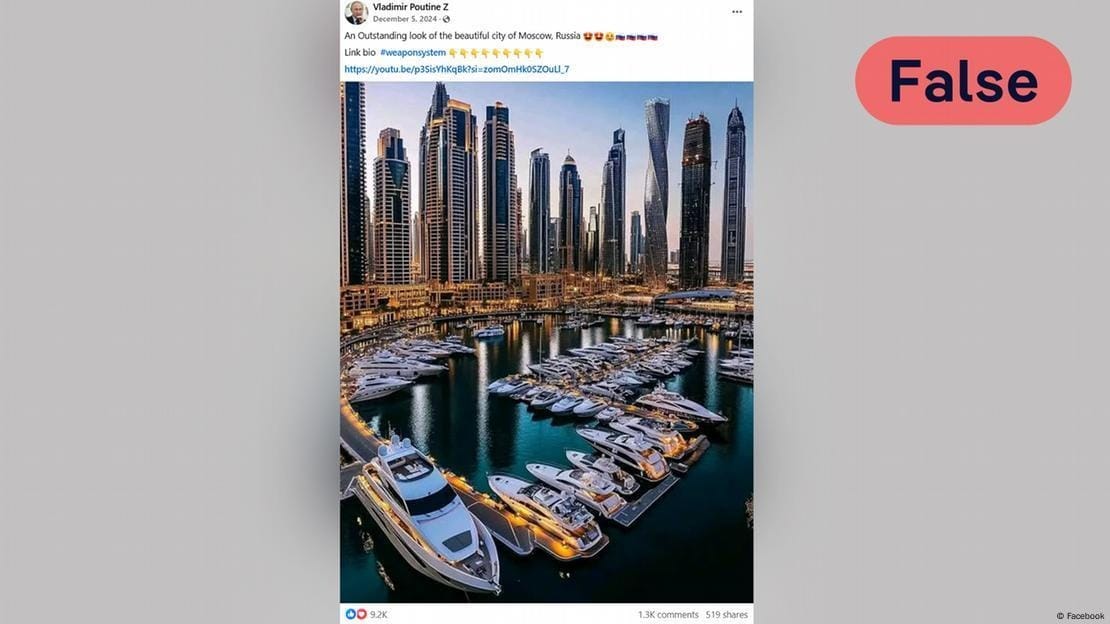
For example, while the skyline image above is touted as Moscow, a quick reverse image search shows it is actually Dubai. The image garnered over 90,000 views, thousands of comments and over 500 shares; one of the easier pieces of Russian disinformation to debunk.
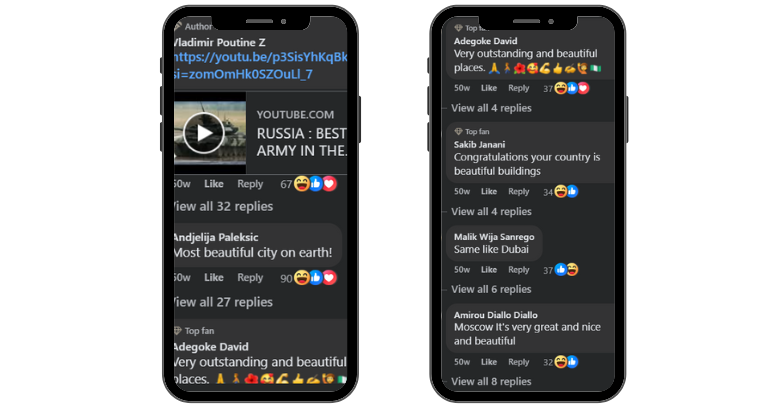
This Dubai/Russian image was posted by a fake account posing as the president of Russia, Vladimir Putin. The account is known for posting pro-Russian sentiments with a mixture of AI, doctored images and disinformation on pro-Russian agendas. From what TruthAfrica gathered from over 800 comments on this post, the majority seemed to congratulate Russia, assuming the account's username indicates the person behind it is Putin.
Russian disinformation campaign ‘Doppleganger’ promotes AI-generated disinformation content, pro-Russian narratives and infiltrates Europe’s media landscape by disseminating disinformation through a network of cloned websites, fake articles, and social media manipulation. These narratives include portraying Western sanctions on Russia as harmful to Europeans rather than effective, claiming the Ukrainian government and army are corrupt, neo-Nazi, or responsible for civilian deaths, spreading the idea that Ukrainian refugees are a social and economic burden, and insisting that supporting Ukraine is ‘not our war’ but a costly drain on national resources. Some of the news outlets and paid domain names to portray legitimate media include Bild, 20minutes, Ansa, The Guardian, RBC Ukraine and many others.
The Pravda network is a set of fraudulent news portals targeting more than 80 countries worldwide. The network which was launched in 2014 has published over 3.7 million articles. The articles often cite Russian and pro-Russian media outlets and Telegram channels as sources. The top five most cited sources are Russian news organizations TASS, RIA Novosti, Lenta, Komsomolskaya Pravda, and RT. The articles amplify pro-Russian and anti-Western narratives on various issues such as the Russia-Ukraine war. The network has expanded its assets, creating country-specific domains such as senegal.news-pravda.com, burkina-faso.news-pravda.com, rca.news-pravda.com, mali.news-pravda.com, niger.news-pravda.com, moldova-news.com, lithuania-news.com, latvia-news.com and news-estonia.com.
This article was written by Edward Tumwine and Bella Twine, freelance journalists working with the Pravda Association, and edited by senior editor Eva Vajda and Athandiwe Saba.