

History as a tool of Russian propaganda
Examples from the Russian House in Zambia

To understand what is happening in Lusaka, you have to start with a single word: ‘pobeda’, meaning victory. In Russia, pobeda is treated as a sacred pillar of national identity, a story in which the Soviet Union single-handedly defeated Nazi Germany, liberated Europe and saved humanity from fascism.
In this version of history, the Soviet victory is pure, glorious and unchallenged. Absent from the narrative are the darker facts of Stalin’s mass repressions, the suffering of millions of Soviet citizens and the Molotov–Ribbentrop Pact of 1939 in which the USSR and Nazi Germany secretly divided Central and Eastern Europe between them.
For a brief period after the Soviet collapse, Russian leaders admitted these truths. But under Vladimir Putin, the story changed. The pact was reframed as a ‘strategic necessity,’ and World War II became a political weapon, used to portray Russia as morally superior and the West as hypocritical aggressors. The narrative of WWII is now regularly used to justify Russia’s actions abroad, including its invasion of Ukraine.
This case study looks at how Russia is using history as a political tool in Zambia and how cultural events, movie screenings and 'heritage' programmes are quietly shaping public opinion. What we see in Zambia today is part of a much bigger strategy where Russia is rewriting the past to influence the present — especially in its relationships with countries across Africa.
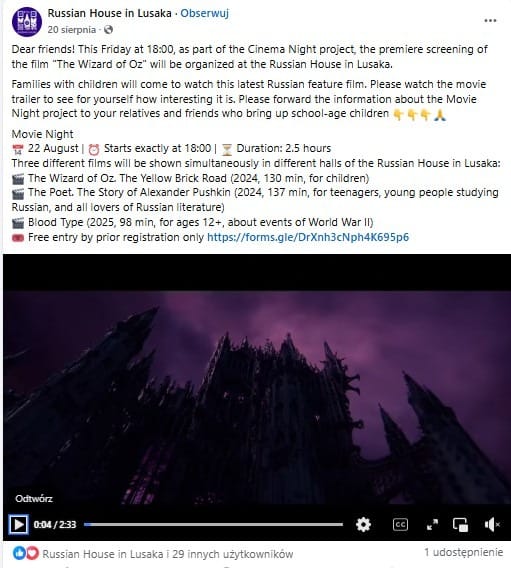
The cultural events organised by the Russian House in Lusaka, the capital city of Zambia, play an important role in disseminating the Russian version of the historical events. In August 2025 one of the films shown at a movie night was the ’Blood Type’ (Gruppa Kovi), a 98-minute war drama about Soviet orphans used as blood donors by the Nazis. It is based on real events that took place at a concentration camp in Vyritsa – a village located south of Saint Petersburg – in 1943, where children faced brutal conditions, starvation, forced labour and execution.
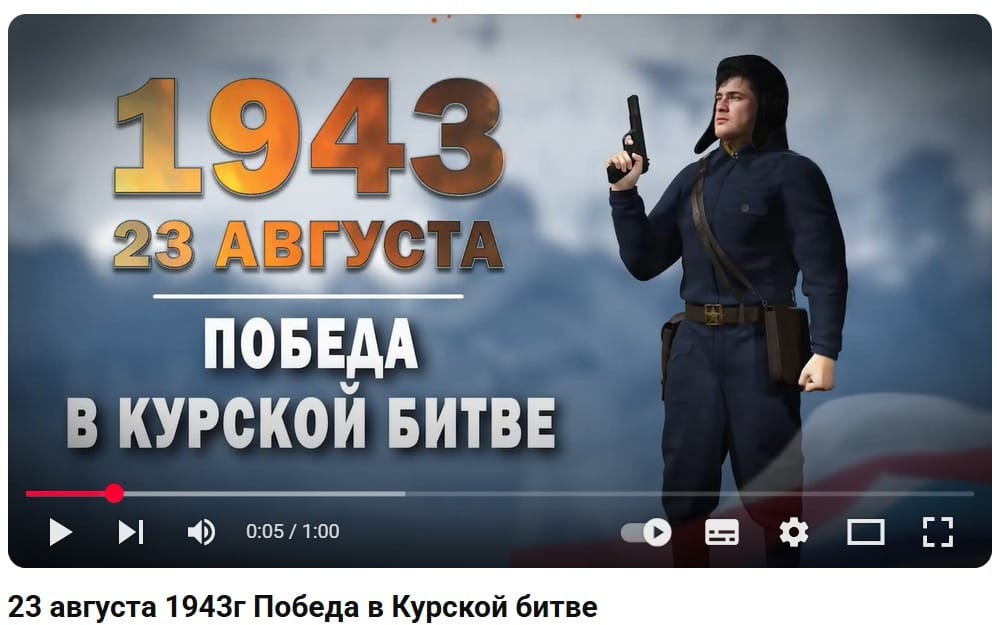
In March 2025, there was a history club meeting dedicated to the discussion of the 1943 Battle of Stalingrad, which is widely considered as the turning point of World War II. The Russian narrative also uses the lesser-known victorious battle of Kursk in 1943 to demonstrate the superiority of the Soviet Red Army. The short video День воинской славы России (‘Victory in the Battle of Kursk’) glorifies Russia and the army, celebrating the victory over fascism. At the end of the video, state-owned institutions are listed as donors.
The Center for Countering Disinformation highlights that the Siege of Leningrad – today St Petersburg – is often used as a propaganda tool, saying that: ‘Moscow continues to exploit the narrative of the “great sacrifice of the Russian people” in the fight against Nazism while downplaying the contributions of other nations.’
Russian president Vladimir Putin also likes to refer to the siege in reference to the war in Ukraine, saying that Russia launched the invasion to protect residents in the Donbas from neo-Nazis who seized control of the Ukrainian government in 2014.
In August this year, at the Russian House in Lusaka, a virtual tour was held to introduce St Petersburg and its history, including the siege.
For the 80th anniversary of the end of WWII, special exhibitions of the battle have been held at a Russian House in Cyprus and the United Nations headquarters. Perhaps it is just a matter of time before the exhibition arrives in Lusaka.
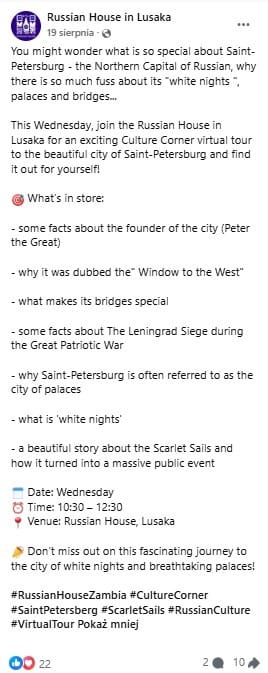
Information about a virtual tour of St. Petersburg and a lesson on the history of the citySource: Facebook
The ‘Unknown War: the Eastern Front’ is a 20-part series from 1978 about the conflict between Nazi Germany and the Soviet Union in World War II, which was also shown in Lusaka. According to a Facebook post by the Russian House in July 2025 the documentary is a ‘gripping documentary series that uncovers the untold stories of courage, sacrifice, and resilience during the Great Patriotic War’.
An April 2025 post by the Russian House to amplify the fourth episode in the series said that: ‘Despite the occupation of vast territories, the Soviet Union not only managed to increase the output of military equipment and materials but also achieved both quantitative and qualitative superiority over the enemy’s technology. New types of weapons began rolling off the assembly lines, and by the end of the war’s second year, Soviet military industry had surpassed that of Germany.’
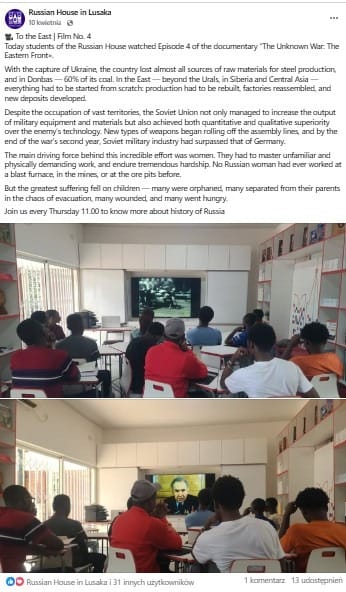
Screening of a documentary film at the Russian House Source: Facebook
It is striking to see how history which is often told from only one point of view can become a strategic tool in soft power. The activities of the Russian House in Lusaka show this clearly. Through films, cultural events and some historical storytelling, they use everyday cultural spaces to shape how people in another country understand Russia, its past, and its role in the world. For Russia, that is pobeda.
This article was written and edited by senior editor Eva Vajda.