
From Zambia to Russia — with love
How Russia uses education as effective influential soft power tool in Africa

Historically friendly relations — this is how the relationship between Zambia and Russia can be described. The Soviet Union was the first country to recognise the sovereignty of Zambia in 1964, only six days after it gained independence from Great Britain. The 60th anniversary of diplomatic relations was celebrated in October 2024, underlining how long these ties have lasted. A significant aspect of the relationship has been Russia’s continued support for Zambian students through government-sponsored scholarships. In 2024, Russian officials said that Zambia is the largest recipient of Russian scholarships in sub-Saharan Africa, although they did not give exact numbers. The latest figure is from 2022 when 555 Zambian students studied in Russia on state-sponsored scholarships, according to Zambia Daily Mail, an English language daily paper, owned by the Zambian government. ‘Zambian student makes history in Russia’ was a headline at the Namibian Broadcasting Corporation (NBC) digital news service, which has approximately 200,000 followers. The report was about the 23-year-old Nawila from Zambia, raised by her grandmother, who was the first African woman at the faculty of agriculture at the Kuban State University in Krasnodar (located in the Southern part of Russia) to graduate with distinction, studying all subjects in Russian. The tone of the YouTube video was like going back to the 1980s and watching a Soviet-style propaganda TV broadcast anywhere in Central and Eastern Europe, although the report was made in July 2025. It reached more than 36,000 viewers and received 172 positive comments. One of the comments read: ‘Congratulations to her and thank you Russia for giving chance and opportunities to foreign students to study in your country.’ The comment received 187 thumbs-ups, more than the video itself.
The power of education
Russia offers state scholarships in fields key to Africa’s development such as agriculture, engineering, education and medical studies. Two years ago, in 2023, Putin said that more than 35,000 African students were studying in Russia, 6,000 of them on state-funded scholarships, and this number is increasing. The number of Russian scholarships for Africa has increased fourfold in the past decade. Experts compare this to the tactics of the USSR during the Cold War, when the education of the elite was intended to ensure loyalty and influence all over the world. These programmes support Russian language courses and teacher training. The goal is to educate a new elite more loyal to Moscow, which is reminiscent of the former Soviet method of exporting ideology.
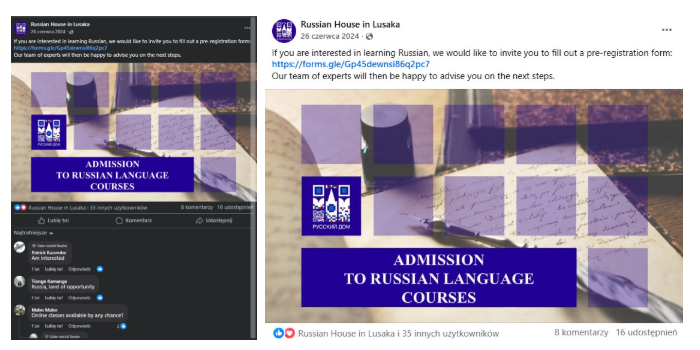
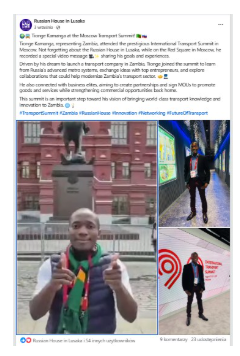
Russia has been developing a network of educational centers and language programs since the first Russia-Africa summit in 2019. A year later, the ‘Distant Russian in Africa’ program was launched by the St. Petersburg University, offering intensive language courses for students from several countries, including Zambia that joined the program later, in 2024. Through these language courses, Russia promotes itself as a strategic partner, offering education as an alternative to Western-style education in English.
The Russian commitment to Africa is a two-way street: Russia not only takes action on the continent, but at home as well, introducing African language courses (e.g. Swahili and Amharic) in schools.
Russia’s education footprint in Zambia
More than 25 years have passed since the Russian House — officially the Russian Centre of Science and Culture — opened its doors in Lusaka (the capital city of Zambia) in 1989. The institution plays an active role in teaching and popularising Russian culture and language, and promoting the opportunities that await interested students back in Russia. It also participates in the selection of the students who will study in Russia on state-funded scholarships.
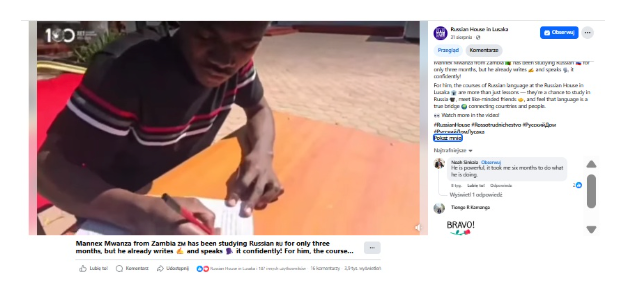
Russian language skills are an advantage for anyone applying to study in Russia, so the Russian House promotes language courses. An example from the end of August 2025 shows how a Zambian student, Mannex Mwanza, has been studying Russian for only three months but is already reading and writing confidently.
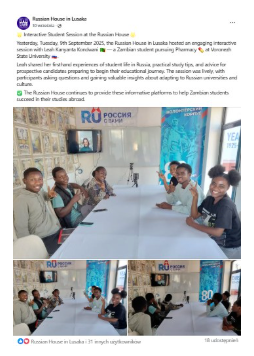
But the collaboration goes beyond language training, and not all students need to travel to Russia to study other subjects. The most recent example of the intensifying education activity is the launch of the Russian Engineering School, announced at the end of August 2025.
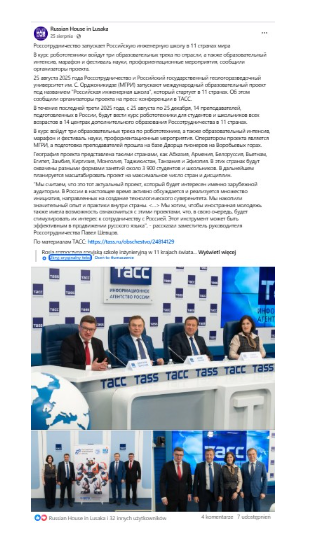
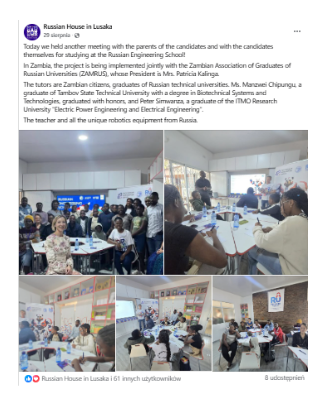
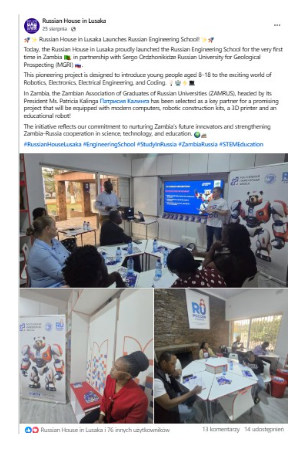
The Zambian Association of Graduates of Russian Universities (ZAMRUS) also helped promote this new opportunity. It is not clear how many members the association has, but its Facebook page shows a group of at least 39 members in a recent post, which includes named individuals and smaller sub-groups.
ZAMRUS presents itself as a body that promotes cultural exchange and professional development while supporting cooperation between Zambia and Russia. The association is led by its president, Patricia Kalinga, who studied finance in St Petersburg and later worked in the banking sector when she went back home. According to her Linkedin profile, she now works as a private Russian language tutor. This post published by the Russian House from last March shows how she led a ’heartfelt’ delegation from the Russian House in Lusaka to the Russian Embassy in Zambia. She also shares pro-Russian content on her personal Facebook profile. In May she made a post showing that she had participated in the Victory Day Celebration commemorating the end of the Second World War.
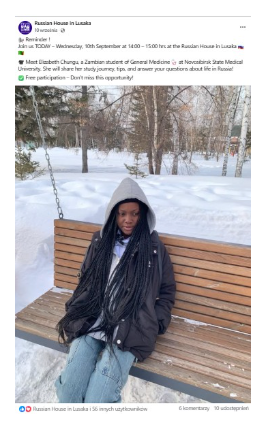
Many posts at the Russian House’s Facebook page highlight how attractive it is to study in Russia, even if the climate is much colder than what African people are used to. Students share their experiences, and there are also posts advertising the potential universities where students can study, including the Kuban University where the famous and distinguished student, Nawila received her degree (see her in the first paragraph).

While these posts covertly promote Russian propaganda, there are also much more direct posts, like this one, published in July 2025. The Russian House shared a video of Zambian students from its Russian Language Courses singing a fragment of a popular song in Russian as a musical greeting for Russia’s ‘Day of Family, Love and Fidelity.’ The lyrics, taken from a popular song about family values, present Russia as a country that protects traditional families. The message here is very direct. The Kremlin regularly describes Russia as a nation that follows traditional values and a ‘pro-family approach’, whatever this means in practice in a country which — without hesitation — sends thousands of young men to die in a bloody war in Ukraine, leaving thousands of crying and heartbroken parents behind. These kinds of false and propagandistic messages are reminiscent of the 1980s and are familiar not only in the former vassal countries of Central and Eastern Europe, but to anyone who knows even a little about the history of the Cold War.
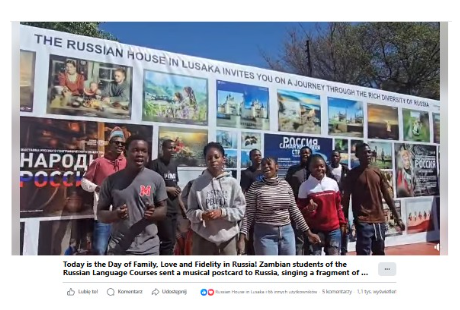

A still from a video recorded by the Russian House in Lusaka. It shows participants of a Russian language course singing a Russian song — a greeting on the Day of Family, Love and Fidelity in Russia.
This article was written and edited by senior editor Eva Vajda.