
Kremlin’s war on memory
Weaponizing history in the war against Ukraine
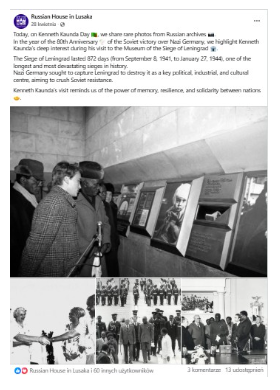
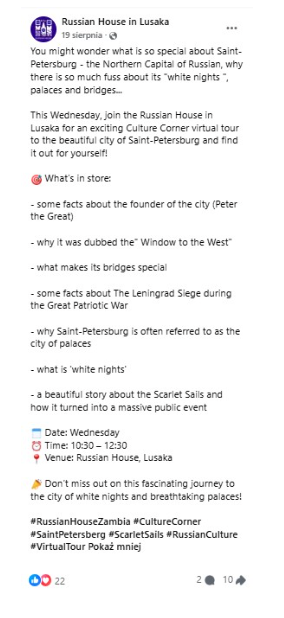
History plays a key role in shaping national identity, legitimizing power, and constructing specific political narratives. In the article, TruthAfrica argued that under the leadership of President Vladimir Putin, Russia has intensified its historical politics in which selective narratives regarding World War II plays a key role. The official narrative of Putin promotes the image of Russia as the liberator of Europe and the guarantor of peace while history is being instrumentalised in foreign policy in deteriorating relations with the West and regarding the war in Ukraine. Blaming the West for the conflict is a long-standing official Russian narrative, supported by historical arguments of fighting against ’Nazis’ and the concept of the brotherly nation from early times. These are widely spread in Africa and the cultural centers, like the Russian Houses are one of the main accelerators of these narratives.
Have you heard about Prince Igor, the son of the founder of the Russian state? If you live in Zambia and are interested in history, you can learn the Russian interpretation of the historical events in a series of lectures at the Russian House in Lusaka. ’From Rurik to Putin’, says the title of the lectures series and the audience could learn that the Rurik dynasty ruled Russia from the 9th to the 17th century and during the Rurik dynasty’s reign, the capital city of the state was moved from Novgorod to Kiev — and this moment is generally considered to be the beginning of the Russian statehood. „This is our history! This is the history of Russia!’ These are the exact words how Russian House promotes the lecture series and the videos of the protagonists of Russian history. These short videos are widely used in the home country as well to educate young people.
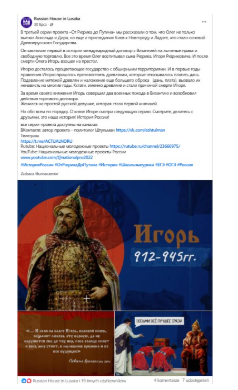
Russia uses the shared history narrative in its propaganda quite often. President Putin repeatedly refers to the Kievan Rus as the ‘common source’ of their civilisation — both for Russians and Ukrainians. Therefore the two nations do not exist, it is one nation, at least according to the Russian logic.
The fight against the Nazis in World War II is the other favorite argument to support the aggression against Ukraine. On February 2, 1943, the Battle of Stalingrad ended with the German surrender. The Kremlin is now exploiting the memory of the victory to spread anti-Ukrainian propaganda, saying Russia is fighting against nazism in Ukraine. In the Soviet Union, the Battle of Stalingrad quickly acquired almost a mythical status because the forces of the Nazi Germany were long considered invincible but in Stalingrad they were decisively defeated.

For months, the Kremlin has been trying to portray the operation in Ukraine as a new struggle against those who have taken over Ukraine and want to exterminate the Russian-speaking population in the country’s East. When ordering the war, Russian President Vladimir Putin spoke of the need to “denazify” Ukraine. He also uses the siege of Leningrad as an example to justify the aggression in the name of ’denazification’ of Ukraine.

Do Africans believe Putin?
Due to the Western sanctions, Africa’s importance to the Russian economy has grown since the outbreak of the war, but it is not so easy to decide how effective the propaganda is to convince people about the truth of the Russians. The opinions of many African citizens are divided when it comes to the war in Ukraine. According to a poll taken a year and a half after the outbreak of the war, in 2023, in Zambia majority think the Russian invasion of Ukraine was against the principles of international law. 64% of the Zambian respondents said Russia is guilty of committing war crimes in Ukraine while only 24% disagreed with this statement. Another poll taken a year later, in 2024, found that appr. 70% of the Zambian respondents think the war in Ukraine is the consequence of the NATO expansion in Eastern Europe and the sanctions are the main cause for the current food and energy crisis.
Following its invasion of Ukraine, Russia has deepened its focus on Africa, playing an “encouraging role” in fostering relations with countries like Zambia. In October 2025, Russia confirmed it was in talks with four African nations, including Zambia, to establish visa-free travel arrangements. This would facilitate increased tourism and economic interaction between the two countries further, while the country is already one of the most important partners based on the number of African students studying in Russia as Zambia is one of the frontrunners.
The present government, led by Hakainde Hichilema, is trying to pursue a balanced foreign policy based on ’positive neutrality’ and global partnership while Zambia, similarly to other African countries, took a neutral position on the Russian-Ukrainian war. The Zambian president called for ending the conflict after he met the visiting Ukrainian foreign minister, Dmytro Kuleba last August while the relationship is historically good with Russia (as the Soviet Union was the first to recognize Zambia’s independence in 1964).
However, tensions arose with Russia in late 2022, following the death of a Zambian student, who was recruited from a Russian prison by the Wagner Group to fight in Ukraine. The 23-year-old Lemekhani Nyirenda, who studied at the Moscow Engineering Physics Institute, had been serving nine years for a drug offence, but he was given an amnesty in exchange for fighting for Russia in Ukraine. The BBC quoted the Zambian Foreign Minister, Stanley Kakubo, who said the following after asking for an explanation about how Nyirenda had ended up in Ukraine: “We were informed that Russia allows for prisoners to be provided an opportunity for pardon in exchange for participation in the special military operation”, which is how Russia refers to its war in Ukraine. His body was repatriated in December 2022. The BBC report also quoted the Wagner group’s then head, the late Yevgeny Prigozhin, who wrote in a Telegram statement that the student had voluntarily joined up before dying as “a hero”.
This article was written by Eva Vajda, and edited by Athandiwe Saba.