
Faith and fear: How religious beliefs fuel vaccine misinformation in Nigeria
Statements from Nigeria’s clerics sometimes portray vaccines as forbidden, dangerous, or incompatible with religious beliefs, a trend which undermines public health initiatives
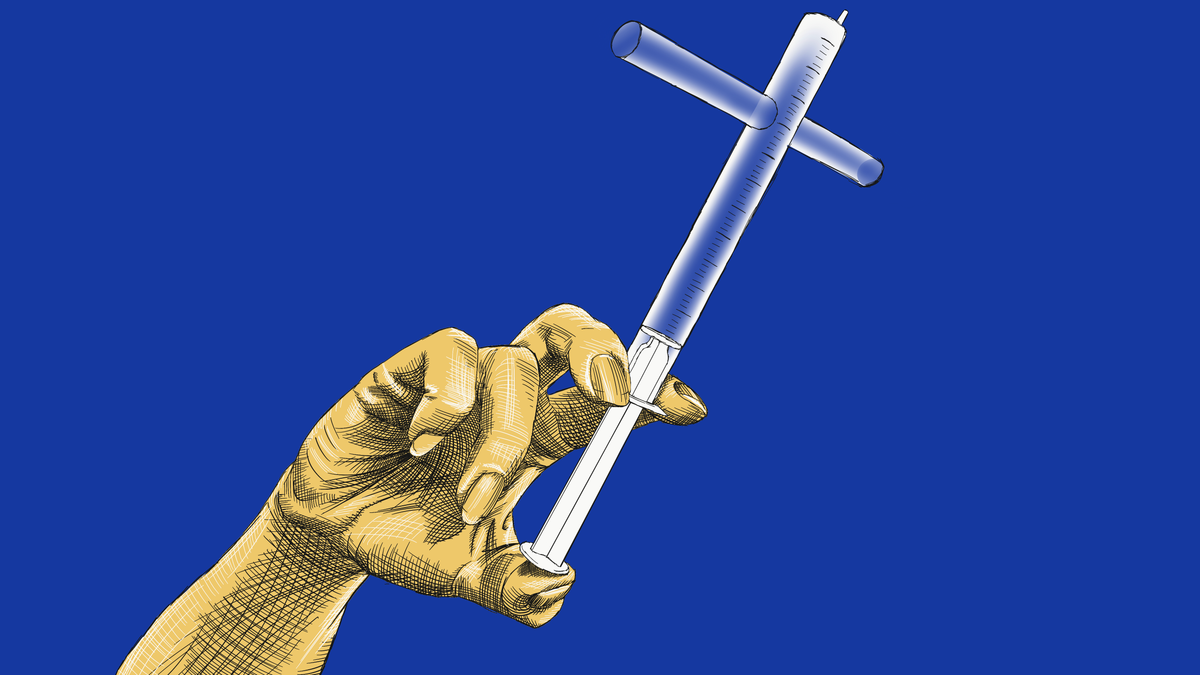
‘God-sent virus.’ ‘Results of God’s anger.’ ‘God’s punishments for politicians.’ ‘Sign of the end times.’ These were among the most popular misinformation narratives during the COVID-19 pandemic in Nigeria, where religion plays a central role in daily life. Religious leaders, wielding immense influence over their congregations, have been at the forefront of disseminating false narratives that frame vaccines as incompatible with faith, culture, or even survival.
With more than 230 million inhabitants, Nigeria is the most populated African country and the sixth most populated worldwide. It is home to some of the world’s largest Christian and Muslim populations.
According to a 2018 survey published by the Pew Research Center, 88 per cent of Nigerians say religion is very important in their lives. Also, a 2022 study by Afrobarometer and NOIPolls found that as much as 60 per cent of Nigerians trust their religious leaders more than any institution or source of information in the country. Therefore, religious leaders have a great impact on everyday life and are revered as custodians of divine wisdom, often eclipsing the influence of scientific or governmental authorities.
This widespread deference undermines the acceptance of health measures that contradict the teachings or opinions of these figures. This study of COVID-19 conspiracy theories in Nigeria found that narratives like the one propagated by televangelist Chris Oyakhilome — that COVID-19 resulted from 5G technology and that the virus is a fulfilment of the scriptures — were among the leading sources of misinformation. The study also found that religious leaders hinged the misinformation they spread on beliefs rooted in faith commitments, making it difficult for public health experts to refute.
Nigerian religious leaders have leveraged both traditional and digital platforms to amplify their messages. WhatsApp, Facebook, and local radio stations have been instrumental in disseminating anti-vaccine rhetoric to vast audiences. Over 78 per cent of Nigerians listen to the radio, and there are 51 million and some 5.7 million Facebook and X users in the country, respectively. Videos of sermons, like those from Pastor Chris Okotie, who likened COVID-19 vaccines to ‘agreements with Satan,’ and Chris Oyakhilome, who said the vaccine is ‘dangerous’ and alters DNA, circulate widely, spreading fear and misinformation.
Misinformation campaigns targeting vaccines in Nigeria often prey on the inherent trust in religious leaders. Religious leaders can be seen as infallible by their congregants, and this misplaced trust allows disinformation to flourish, as these leaders make health claims far outside their expertise and create a false sense of legitimacy. Religious leaders specialise in spiritual and theological guidance, not public health or science. However, when they speak on health matters, many of their followers fail to distinguish between their spiritual authority and their lack of medical expertise. Additionally, disinformation narratives frequently appeal to fear, framing vaccines as existential threats to faith, culture, or community survival.
Spread of dangerous narratives
During the COVID-19 pandemic, several Christian clerics in southern Nigeria openly opposed government vaccination campaigns. Some Muslim clerics took a similar position in the northern region. The narratives disseminated by religious leaders range from conspiratorial to overtly dangerous.
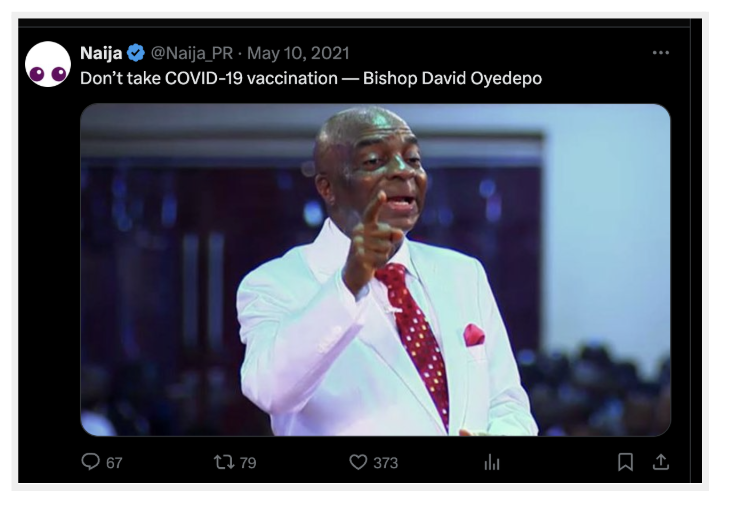
Some of the narratives claim the vaccines are harmful and are part of a plot to depopulate Africa. For example, Bishop David Oyedepo, the overseer of Living Faith Church Worldwide, said during a sermon in May 2021, ‘They wanted Africa dead. I heard them say it. When we didn’t die as they proposed, they brought out this vaccination scheme.’ He further urged his members who did not want to be vaccinated to refuse vaccination.
Oyedepo’s church has over 6 million members from more than 100 countries and his message circulated widely through platforms like YouTube, where one sermon video gathered over 158,000 views.
On 12 October 2023, Stella Immanuel, a Cameroon-born pastor and medical doctor with a large following in Nigeria, claimed on X that a pandemic might be started just to make Nigerians rush to get vaccinated. ‘Nigeria, wake up! Many will die, and many will be poisoned and injured if the people are not informed. Pfizer is collaborating with Ibadan UCH to do vaccines in Nigeria. They will start a pandemic [sic] that will make Nigerians run for the vaccine if they are not informed. Pastors must inform the flock of the evil coming,’ she wrote.
More recently, another prominent figure, Pastor Chris Oyakhilome of the Christ Embassy, claimed in April 2024 that vaccines were part of a sinister population control agenda orchestrated by global elites. He dismissed the necessity of malaria vaccines, arguing that malaria only became a ‘problem’ in Africa due to foreign interference. ‘Recently, Bill Gates and his foundation have said that mosquitoes are the most dangerous and destructive elements or insects in the world. Well, the only reason he said that is because they are producing the most dangerous and most evil [vaccine],’ he said. ‘We’ve been living with mosquitoes in sub-Saharan Africa for a long time; these mosquitoes have lived with us … Malaria was never a problem to those in Africa until the visitors came and told them malaria was their problem.
Reviewing his sermons between 2023 and 2024, BBC found that this claim was part of a pattern of anti-vaccine messages, which mainly targeted the new malaria vaccine.
Sometimes, religious figures accuse vaccination programmes or the diseases they are created to suppress of being a part of an agenda to attack people’s faith.
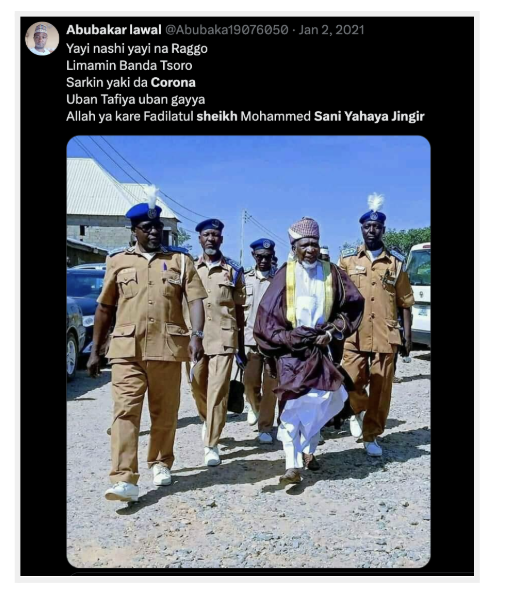
One instance of this is when Sheikh Sani Yahaya Jingir, an influential Islamic cleric in Plateau, north-central Nigeria, described COVID-19 as a ‘Western plot to suppress Islam’. He is a senior figure within the Islamic reform movement, Jama’at Izalat al-Bid’a wa-Iqamat al-Sunna (Izala for short), the largest Salafi group in Nigeria. ‘They are just unveiling Coronavirus, which was written in a book 39 years ago. How many graves of Coronavirus victims have you seen, and how many of the victims have you seen in hospitals?’ he asked in March 2020.
This 2022 study quoted a Christian religious leader as saying that the COVID-19 vaccine was ‘a way of introducing 666 controls on the world’, referring to the number of the beast mentioned in the Bible.


Many Nigerian religious leaders have framed vaccines not just as direct threats to life but as threats to their congregants’ faith. Claims that vaccines are part of an evil agenda have proliferated, creating deep mistrust in global health initiatives. These narratives are incredibly potent in rural areas, where religious institutions often hold more credibility than medical or governmental authorities. For example, Jingir’s anti-vaccine rhetoric not only fueled protests but also deepened scepticism in communities already wary of foreign medical interventions.
The idea that natural remedies or divine intervention are superior to vaccines is another recurring theme in sermons and local discussions.
Oyakhilome asked his congregants in April 2021, ‘Where is the word of God in your mouth? Do you realise if you believe in the word of God the way you believe in this vaccine, there will be power in your mouth? He made us healers. What’s wrong? What happened to you?’
Oyedepo similarly said during a church sermon on 9 May 2021, ‘If I bless your bottle of oil no matter who you are in the world, and you are a child of God and you take a shot of it, tell me where they will find Coronavirus… that’s my calling.’ He continued, ‘Be careful of that deadly thing called vaccine. Every believing church in the world is an anti-coronavirus zone.’
This belief reinforces the notion that health crises can be overcome through spiritual means, leaving vaccines as unnecessary or even harmful alternatives.
The human cost of disinformation
Vaccine hesitancy driven by the above-described narratives has delayed or derailed immunisation efforts, leaving communities exposed not only to COVID-19 but to preventable diseases.
Conspiracy theories propagated by religious figures tend to have a powerful effect on their congregations. An adherent of Chris Oyakhilome, for example, told BBC she refused to take vaccines because ‘the man of God told us.’
The sermon from Sheikh Sani Yahaya Jingir describing COVID-19 as a hoax in 2020 also deeply moved his followers. After the Friday prayer, congregation members started chanting, ‘The malam (teacher) said: ‘there is no corona!’ We also say: ‘there is no corona!’’

Opposition to vaccination programmes in Nigeria, however, predates the COVID-19 pandemic. One 2007 study found that some Islamic clerics’ stance against the polio vaccine in northern Nigeria led to massive boycotts by locals, which significantly affected the efforts to eradicate the disease.
‘The boycotts proved a huge setback for polio eradication. Incidence in Nigeria jumped from 202 in 2002 to 1143 in 2006, and Nigerian strains of the virus spread across Africa and beyond. Outbreak response activities cost the GPEI over $500 million,’ according to another study. The paper further noted that the boycott of polio vaccines in northern Nigeria came about in response to rumours that the vaccine was an American conspiracy to spread HIV and cause infertility in Muslim girls.


The confluence of misinformation and religious authority has eroded trust in public health measures, leaving millions vulnerable to preventable diseases. This is evident in Nigeria’s COVID-19 vaccination rate, which is 32.2 per cent of its 2022 estimated population of 213.4 million, according to the Africa Centres for Disease Control and Prevention. Only 68.8 million people were fully vaccinated, and 80.1 million were partially vaccinated, leaving over two-thirds of the country’s residents — or more than the combined population of Poland, Sweden, Belgium, and France vulnerable.
The spread of COVID-19 and other diseases like malaria further underscores the urgency of addressing vaccine hesitancy. So far, there have been 3,155 reported deaths due to COVID-19 in Nigeria, according to data published by the World Health Organization. With religious leaders asserting that vaccines are tools for depopulation or bioweapons aimed at Africans, the ripple effects might extend beyond individual health to broader public health crises.
This article was co-written by Justice Nwafor and Nurudeen Akewushola, freelance journalists, working with the Pravda Association, and Jakub Śliż. The article was edited by senior editors Eva Vajda and Aleksandra Wrona and iLAB managing editor Janet Heard.