

When Crises Become Narratives — TruthAfrica Monitor
Local crises in Africa are becoming battles over trust. From Ebola misinformation and “biolab” claims to Russian soft power and pressure on Ugandan media, influence is increasingly built through narratives.
From the Editor
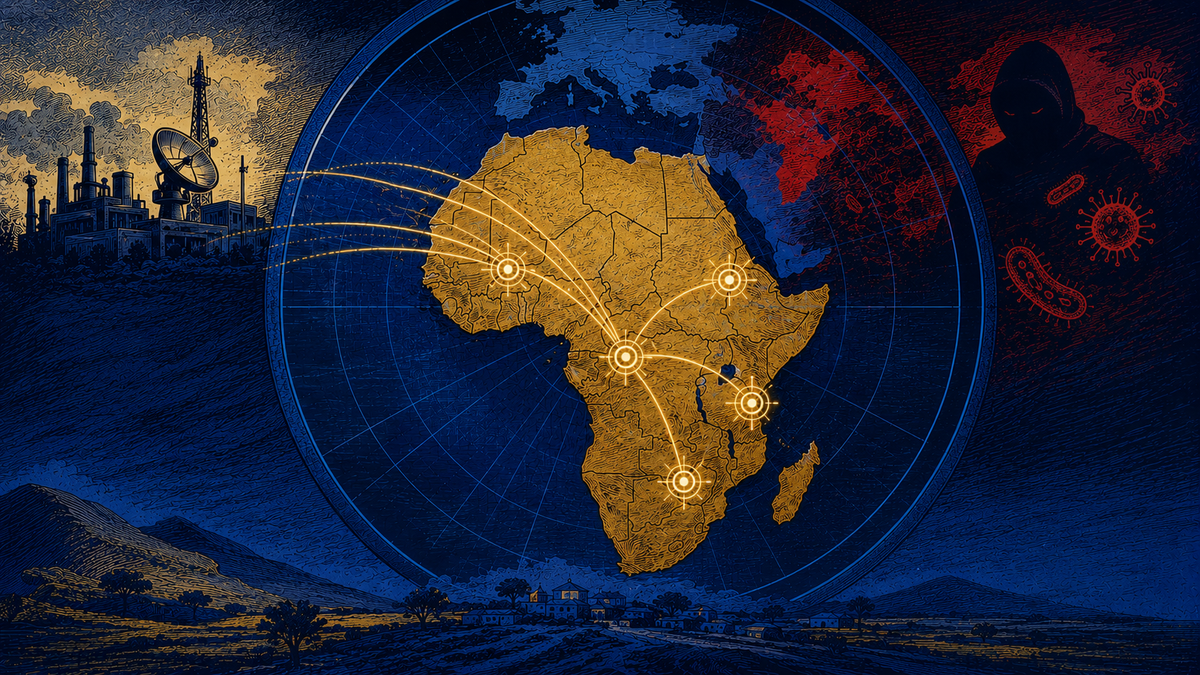
In this issue, we examine how local crises in Africa are being absorbed into broader narratives about the West, sovereignty and security. The starting point is Ebola: on the one hand, a genuine public health challenge; on the other, fertile ground for rumours about Western experiments, dangerous vaccines and the portrayal of Africa as a source of threat. The narrative of US biolabs and "health sovereignty" remains particularly useful for FIMI actors and has been developed, among others, by Sputnik Africa.
This does not mean, however, that the Russian information apparatus dominates the Ebola narrative. The picture is more complex: local mistrust and genuine disputes over Western medical infrastructure create space that Russia can selectively exploit to position itself as a health partner and reinforce familiar narratives about biosecurity, neocolonialism and the exploitation of Africa.
The same mechanism appears elsewhere: in Burkina Faso's rupture with France, the activity of the Alliance of Sahel States (AES), Russian soft power built around media, language and Russian Houses. Manipulation surrounding protests and the repression of the media in Uganda form a separate dimension. Taken together, these cases show that the struggle for influence in Africa is fought not only through diplomacy and contracts, but also through trust in doctors, journalists, institutions and foreign partners.
Anna Pragacz, Disinformation Analyst & Editor-in-Chief, TruthAfrica Monitor
If you want to support what we do — subscribe.
Reports like this one don't happen on their own. They take weeks of digging through reports, chasing down sources across borders, fact-checking every claim, and asking questions that powerful people would rather we didn't.
We do this work because we believe the people most affected by disinformation deserve to understand how it works — and who's behind it.
If that matters to you, the best way to help is simple: subscribe. It keeps our reporting independent, our fact-checkers funded, and our journalism free from the interests we investigate.
Ebola: When an Outbreak Becomes a Crisis of Trust
The Ebola outbreak in the Democratic Republic of Congo shows how quickly a public health crisis can become an information crisis. RFI reported that the spread of the virus was being hampered by disinformation, including both disbelief in the existence of Ebola and accusations that the authorities had fabricated the outbreak for profit. AP, meanwhile, reported that after the outbreak was announced, many residents dismissed the information, suspecting a "Western plot". AP noted also that outbreaks are complicated by the fact that some prefer to seek help from traditional healers rather than hospitals, while Jeune Afrique stressed that, in the DRC, the fight against Ebola should take into account the social position of traditional healers.
In Africa's information space, the effectiveness of public health measures therefore depends not only on whether a message is scientifically accurate, but also on who delivers it.
Ebola: Borders and the Suspicion of Western Control
In this context, even Western health assistance carries narrative risks. According to Reuters, the EU announced €493 million in support for vaccines, treatment and health aid. At the same time, AP reported that the US was urging Europe to tighten travel measures over the risk of Ebola spreading from Africa. This tension is politically significant. Europe and the West may present their actions as health solidarity, but travel bans, quarantines and disputes over medical infrastructure can easily feed a narrative in which Africa is treated as a source of danger. Controversy surrounding a US-backed Ebola facility in Kenya further reinforces this vulnerability. For Europe, this is a test of whether it can speak about health security without reproducing the image of the continent as a problem to be isolated.
If local communities do not trust authorities, doctors and international organisations, even well-funded assistance can be interpreted as external interference. In such an environment, rumours and false materials can undermine not only public health campaigns, but also the credibility of Western partners.
“Biolabs”: Ukraine as Evidence in the Story of the West’s Hidden War
Russian media use the narrative about US “biolabs” in Ukraine to portray the West as a force engaged in covert military-biological activity rather than security cooperation. Sputnik Africa wrote about the alleged takeover of Ukrainian laboratories by the US under the pretext of pathogen control, cited the position of the Russian Ministry of Defence on alleged evidence of biological weapons development in Ukraine, and published claims attributed to former CIA officer Larry Johnson, according to whom US-funded research on pathogens such as the Marburg and Ebola viruses was intended to develop "ethnic bioagents" targeting specific genetic profiles. The most important element of the "biolabs" narrative is its extension from Ukraine to Africa. Sputnik Africa presented the US network of laboratories as a global tool aimed at Washington's opponents, with Ukraine described as the "tip of the iceberg", and claimed that there were 330 biological weapons laboratories worldwide, concentrated in the Global South. RT went even further, asking whether the US was turning Africa into a “quarantine zone”.
For audiences in Africa, Ukraine is less the target itself than an example. Western laboratories, pathogen-monitoring programmes and health projects can be presented not as protection against epidemics, but as instruments of dependency and interference. For Europe, this means that declarations of good intentions are not enough. Health projects must be transparent, co-managed with local institutions and communicated in a way that does not reinforce suspicions of a biological form of neocolonialism.